
Why Stress Relief Is the #1 Reason People Try Breathwork
The American Psychological Association reports that 77% of Americans regularly experience physical symptoms caused by stress. That number has been climbing for years. And for most people, the usual advice (sleep more, exercise, take a vacation) doesn't address what's actually happening in their nervous system.
Stress isn't just a mental problem. It's a physiological state. When your body is stuck in fight-or-flight mode, no amount of positive thinking will turn it off. That's exactly why so many people find their way to Breathwork. It works on the body directly, not just the mind.
We hear it constantly at Liquid Breathwork: "I've tried everything, and this is the first thing that actually made me feel different." That's not hype. It's what happens when you give your nervous system the input it needs to shift gears.
How Breathwork Reduces Stress (the Science)
Breathwork isn't a placebo. The mechanisms are well documented and measurable.
When you slow your exhale and breathe with intention, you stimulate the vagus nerve. This is the longest cranial nerve in your body, running from your brainstem to your gut. Vagus nerve activation triggers the parasympathetic nervous system (your rest-and-digest mode), which lowers cortisol, reduces heart rate, and decreases blood pressure.
A 2023 study published in Cell Reports Medicine by Stanford researchers found that cyclic sighing (a specific Breathwork pattern) was more effective at reducing stress and improving mood than mindfulness meditation. Participants who practiced just five minutes of structured breathing daily showed significant improvements in positive affect and reduced anxiety.
Here's what happens in your body during a Breathwork session:
- Cortisol drops. Extended exhales signal safety to the brain, pulling cortisol levels down within minutes.
- Heart rate variability (HRV) improves. Higher HRV is one of the strongest biomarkers for stress resilience and overall health.
- Brainwave patterns shift. You move from beta (alert, often anxious) into alpha and theta states (calm, creative, restorative).
- Muscle tension releases. The diaphragm relaxes, which loosens the entire chain of tension through the chest, shoulders, and jaw.
This isn't something you have to practice for months to feel. Most people notice a shift within 10 to 15 minutes of their first guided session.
Breathwork vs Other Stress Relief Modalities
There's no single "best" tool for stress relief. Different modalities work on different layers of your experience. At Liquid Breathwork, we offer Breathwork, sound healing, meditation, and Reiki because we've seen how they complement each other.
Here's how they compare:
- Breathwork works directly on the nervous system through active breath patterns. Fast-acting, highly physical, great for people who struggle to "sit still and relax."
- Sound healing uses external frequencies to entrain your brainwaves into relaxation. Deeply passive (you just lie there and receive).
- Meditation trains attention and awareness over time. Builds long-term mental resilience but requires consistent practice to see results.
- Reiki works on the energetic body. Subtle, gentle, and especially effective for people holding emotional stress they can't quite name.
Think of Breathwork as the on-ramp. It gets your nervous system into a receptive state quickly, which makes every other modality work better.
Sound Healing for Stress Relief
Sound healing uses instruments like crystal singing bowls, Tibetan bowls, gongs, and tuning forks to produce resonant frequencies. These frequencies interact with your brainwaves, gradually slowing them from beta (active thinking) into alpha, theta, and sometimes delta (deep sleep) states.
A 2020 study in the Journal of Evidence-Based Integrative Medicine found that participants in a singing bowl session experienced significant reductions in tension, anxiety, and depressed mood. Blood pressure and heart rate also decreased during sessions.
What makes sound healing so effective for stress is how little effort it requires. You lie down, close your eyes, and let the sound do the work. There's no technique to learn, no breath pattern to follow. Your body responds to the vibrations automatically.
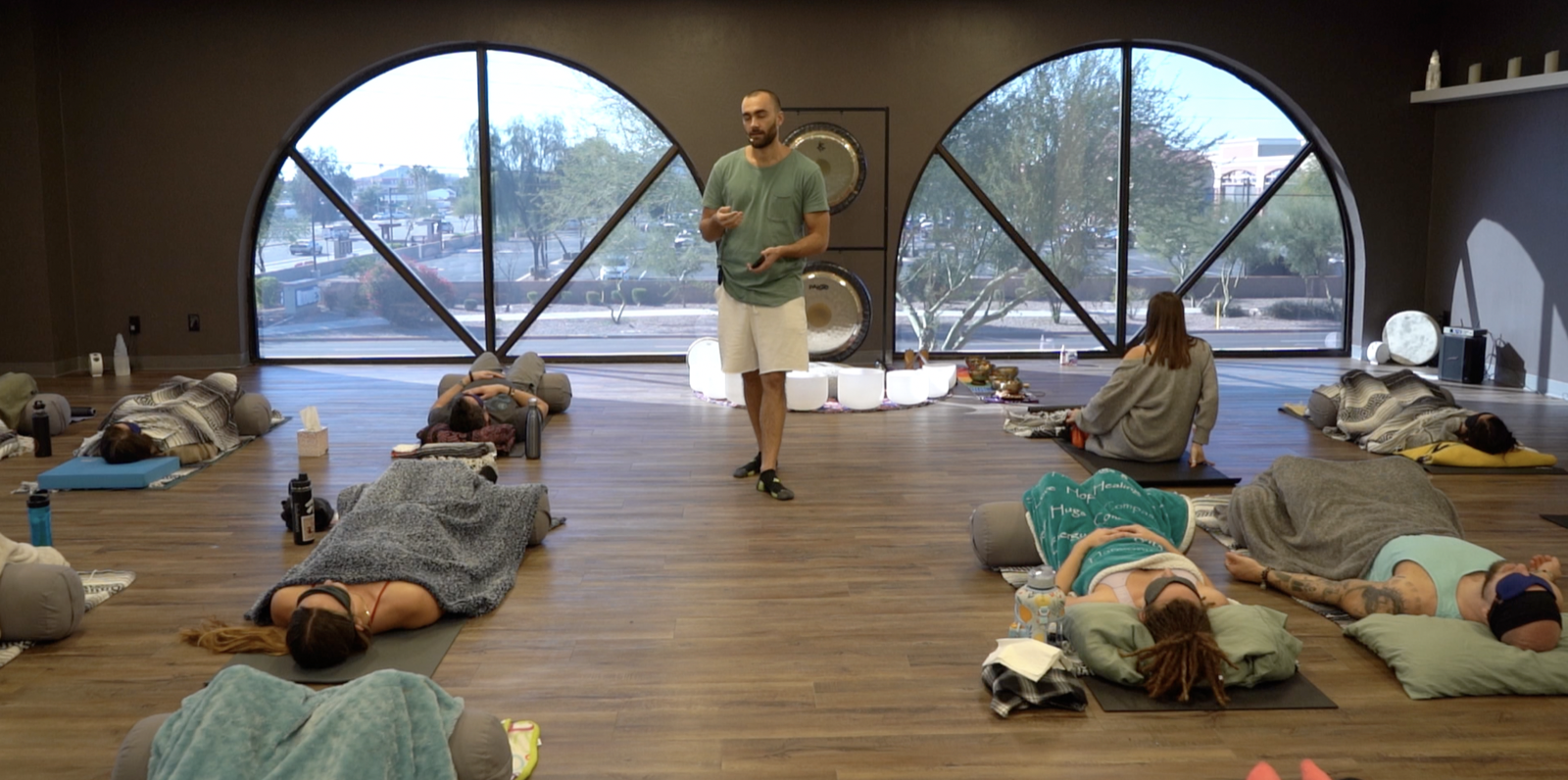
We pair sound healing with Breathwork in many of our Arizona classes. The combination is powerful: Breathwork opens the nervous system, and sound healing deepens the release. People regularly describe the experience as "the most relaxed I've been in years."
Meditation for Stress Relief
Meditation and Breathwork get grouped together often, but they're fundamentally different practices. Meditation is about observation. You watch your thoughts, notice sensations, and practice non-attachment. Breathwork is about action. You use specific breath patterns to create a direct physiological change.
That distinction matters for stress relief. Meditation builds your capacity to handle stress over time by training your attention and emotional regulation. It's a long game. Research from Harvard, Johns Hopkins, and dozens of other institutions consistently shows that regular meditation reduces anxiety, improves focus, and even changes the structure of the brain (increased gray matter in the prefrontal cortex).
The challenge? Many people who are highly stressed find it nearly impossible to meditate. A racing mind doesn't quiet down just because you told it to. That's where Breathwork comes in as the perfect complement. A 10-minute Breathwork session before meditation calms the nervous system enough that stillness actually feels accessible.
For people new to wellness practices, we often recommend starting with Breathwork and adding meditation as the nervous system stabilizes. They amplify each other.
Reiki for Stress Relief
Reiki is a form of energy work that originated in Japan. During a session, the practitioner places their hands on or near your body at specific points, facilitating the flow of energy to support balance and relaxation. You stay fully clothed the entire time.
Most people describe the sensation as gentle warmth, tingling, or a feeling of heaviness as the body relaxes. Some feel emotional release (tears are common and perfectly normal). Sessions typically last 45 to 60 minutes.
The research on Reiki is still growing, but multiple studies (including a 2017 review in the Journal of Evidence-Based Complementary & Alternative Medicine) have found that Reiki sessions reduce anxiety, pain perception, and stress markers. It's now offered in over 800 hospitals across the United States as a complementary therapy.
Reiki is especially effective for people carrying stress that feels stuck or hard to identify. Where Breathwork addresses the nervous system directly and meditation works with the mind, Reiki works on a subtler level. It can reach patterns that the other modalities don't always access on their own.
Building a Stress Relief Practice
The most effective approach to stress relief isn't choosing one modality. It's building a practice that combines them based on what your body needs.
Here's what we recommend for getting started:
- Start with Breathwork. It's the fastest way to shift your nervous system out of chronic stress. Even one class can change how you feel day to day.
- Add sound healing or Reiki. Once you know what Breathwork feels like in your body, layer in a passive modality. This deepens the work without requiring more effort from you.
- Build a meditation habit. Even five minutes daily makes a difference. Use Breathwork as a warm-up if sitting still feels hard.
- Stay consistent. One session feels great. A weekly practice changes your baseline. Our membership gives you virtual access plus 50% off in-person classes, making it easy to build a routine.
At Liquid Breathwork, we run weekly classes across Scottsdale, Tempe, and the greater Phoenix area. Many of our sessions integrate Breathwork with sound healing, so you get multiple modalities in a single class. No experience required.
Frequently Asked Questions
How does Breathwork reduce stress?
Breathwork activates the vagus nerve, which triggers the parasympathetic (rest-and-digest) nervous system. This lowers cortisol, slows heart rate, and shifts your body out of fight-or-flight mode. Most people feel a noticeable difference within 10 to 15 minutes of guided practice.
What is the difference between Breathwork and meditation for stress relief?
Meditation typically involves observing thoughts and stillness. Breathwork is an active practice where specific breath patterns directly regulate the nervous system. Both reduce stress, but Breathwork tends to produce faster physiological shifts, while meditation builds long-term awareness and focus.
Can sound healing help with stress and anxiety?
Yes. Sound healing uses resonant frequencies from singing bowls, gongs, and tuning forks to slow brainwave activity into theta and delta states. Research shows these frequencies reduce anxiety, lower blood pressure, and promote deep relaxation.
What does a Reiki session feel like?
Most people describe Reiki as a gentle warmth or tingling sensation. You remain fully clothed while the practitioner places their hands on or near your body. Sessions typically last 45 to 60 minutes and leave you feeling calm, grounded, and lighter.
Can I combine Breathwork with sound healing or Reiki?
Absolutely. Combining modalities is one of the most effective approaches. Breathwork opens the nervous system, sound healing deepens relaxation, and Reiki supports energetic balance. At Liquid Breathwork, many of our classes integrate multiple modalities in a single session.
Ready to Let Go of Stress?
Join a Breathwork, sound healing, or meditation class this week.