If you're a student at Arizona State University looking for Breathwork near ASU, you're probably already stressed. Good news: somatic Breathwork in Tempe, Arizona (yes, Tempe Arizona, not Scottsdale) is the fastest path to real stress relief and emotional well-being we've found. One session. No experience needed. You just lie down and breathe.
The College Stress Crisis at ASU
Over 60% of college students reported overwhelming stress and anxiety in the past year, according to the American College Health Association. At Arizona State University (the largest public university in the country), the pressure is even more concentrated. Academic stress, financial pressure, social media comparison, and the constant question of "what am I doing with my life?" hit all at once.
Student mental health resources on campus are stretched thin. Therapy waitlists run weeks or months. Most campus wellness advice boils down to "try deep breathing" or "go for a walk." And let's be real: most students end up coping with doom scrolling, caffeine, or just white-knuckling through burnout until the semester ends.
The problem isn't that college students don't want help. It's that the coping strategies most people recommend don't match the intensity of what students are actually feeling. You don't need another app telling you to take three deep breaths. You need something that resets your nervous system at a level you can physically feel. That's where Breathwork comes in.
What Breathwork Actually Is (and How It's Different)
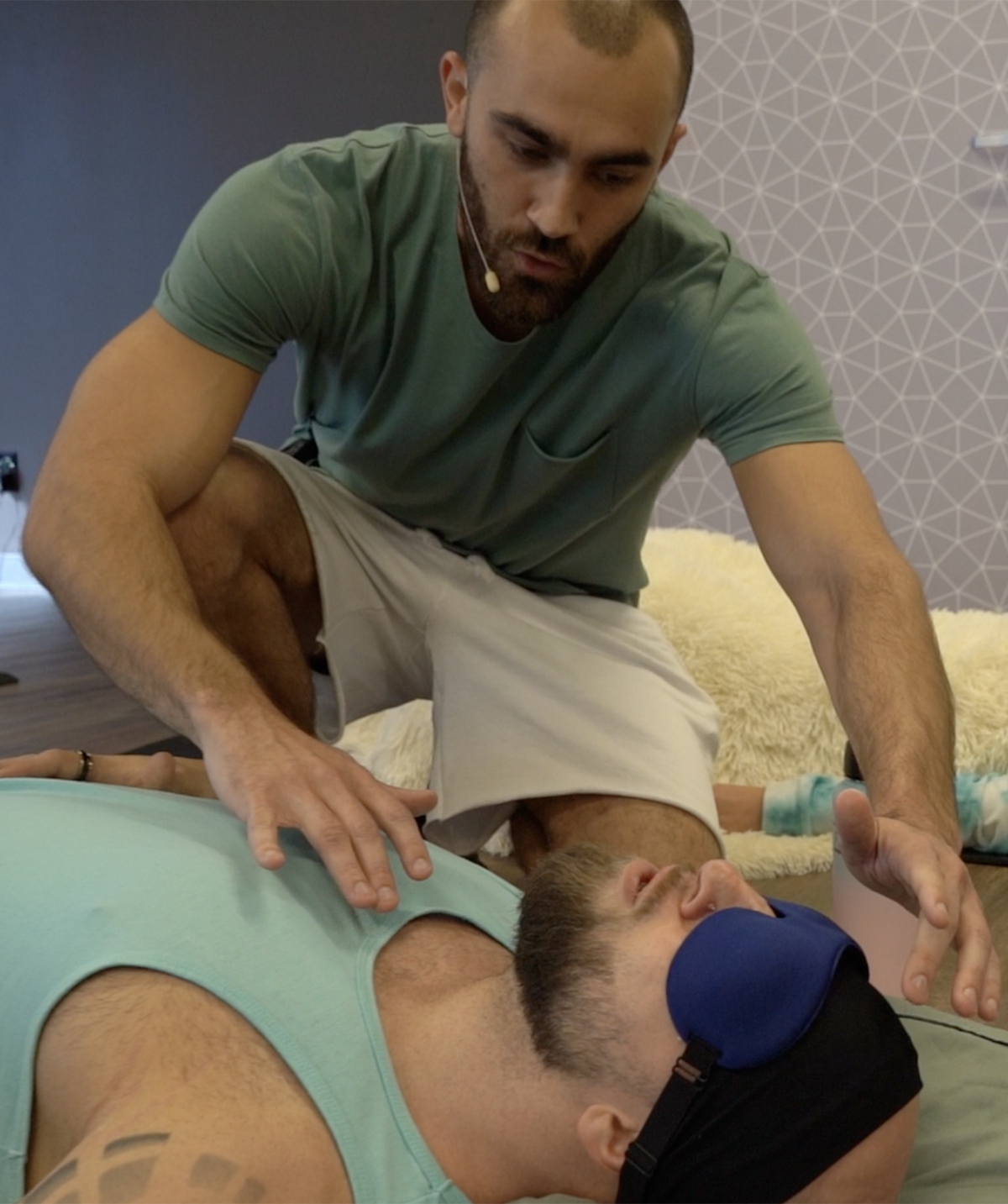
Breathwork classes aren't what most people picture. There's no incense circle. No one asks you to find your spirit animal. At Liquid Breathwork in Tempe, you lie down on a mat with a pillow and blanket. We guide you through a specific conscious connected Breathwork pattern set to music with live sound healing and Reiki. That's it. You breathe, your body does the rest.
Our method is surrender-based and trauma informed. We don't push you toward catharsis or emotional overwhelm. Our Breathwork practitioner and co-facilitator Shelby Von Oepen is a registered nurse (RN, BSN), so safety is built into every session, not bolted on after the fact. Every guided breathing session includes sound healing and Reiki as standard (not add-ons you pay extra for).
How It's Different from Meditation and Yoga
Meditation asks you to sit still and observe your thoughts. That's valuable, but it takes months of practice before most people feel a real shift. Breathwork delivers a noticeable change in your stress levels in a single session. You don't need to quiet your mind. You don't need flexibility.
Yoga is a physical movement practice with breathing exercises built in (like pranayama or diaphragmatic breathing). Those are helpful for daily maintenance. But somatic Breathwork works at a deeper level. It accesses your nervous system directly and creates space for emotional processing that stretching and holding poses can't reach.
And if you've heard of box breathing (used by the military for acute stress), breath of fire (a rapid technique from Kundalini traditions), Wim Hof (cold plunge plus intense breathing), or shamanic Breathwork (which can be intensely cathartic), those are all different modalities with different goals. Our conscious connected Breathwork is designed for nervous system regulation and emotional resilience, not performance hacking or spiritual fireworks.
The Science Behind Breathwork
The benefits of Breathwork aren't just anecdotal. Evidence-based research from the NIH and peer-reviewed studies show that structured breathing techniques directly activate the parasympathetic nervous system (your body's rest-and-digest mode) through stimulation of the vagus nerve.
When you're chronically stressed, your autonomic nervous system gets stuck in fight-or-flight. Cortisol stays elevated. Sleep suffers. Focus tanks. Breathwork triggers cortisol reduction by shifting you out of sympathetic overdrive and into parasympathetic activation. The result: measurable anxiety reduction, improved emotional regulation, and a calmer baseline state. This is the mind-body connection in action, not a buzzword, but a physiological reality backed by self-regulation research.
That's what makes Breathwork different from just "taking a few deep breaths." It's a structured, evidence-based practice that creates lasting change in how your nervous system responds to stress reduction demands.
Why Breathwork Works for College Students
College stress isn't one thing. It's a stack of pressures hitting at the same time. Breathwork addresses the root (your nervous system state) rather than just the symptoms. Here's how it maps to the specific challenges students face.
Exam Stress and Academic Performance
Your brain doesn't perform well under chronic exam stress. When your nervous system is stuck in survival mode, your prefrontal cortex (the part that handles critical thinking, memory, and focus) goes partially offline. That's why you can study for hours and still blank on a test. Test anxiety isn't a willpower problem. It's a nervous system problem.
Breathwork brings your prefrontal cortex back online by downregulating the stress response. Students who practice breathing techniques before exams report sharper mental clarity, better recall, restorative sleep the night before a test, and less panic. It's not magic. It's what happens when your brain isn't flooded with cortisol and you can access peak performance under pressure.
Social Anxiety and Loneliness
College is supposed to be the best years of your life (which makes it worse when you feel isolated). Social anxiety keeps your nervous system in a hypervigilant state. Every interaction feels like a threat assessment. Breathwork helps reset those patterns by teaching your body that it's safe to relax around other people.
And because our classes are done lying down with your eyes closed, there's zero social performance pressure. No one is watching you. No one is judging your form. It's the opposite of every other group activity on campus, which makes it weirdly effective at building emotional balance in social situations.
Burnout and the Doom Scroll Cycle
Burnout culture is the default setting for most ASU students. Class, work, study, scroll, sleep (maybe), repeat. Your phone keeps your nervous system in a constant state of low-grade activation. Notifications, comparisons, algorithmic anxiety. You know the cycle.
Breathwork is one of the few stress management tools that can actually interrupt that loop at the physiological level. One session works as one of those rare study breaks that actually recharges you (instead of doom scrolling for 45 minutes and feeling worse). Students who come regularly say it's the only thing that gets them off autopilot.
Identity and Transition Stress
Who am I outside of my parents' house? What do I actually want? Am I in the right major? These questions create a low-grade existential pressure that doesn't show up on any syllabus. You can't think your way out of an identity crisis. But you can create space for clarity to emerge.
Breathwork supports emotional resilience during transitions by helping your body process what your conscious mind can't figure out yet. It's not therapy (more on that below), but it complements the kind of self-reflection that college demands. Physical activity handles the body. Breathwork handles the emotional layer underneath.
What to Expect at a Breathwork Class Near ASU
Our Tempe Breathwork sessions happen at InnerVision Yoga (6448 S McClintock Dr, Tempe, AZ 85283), a short drive from ASU campus. We host weekly in-person classes and periodic workshops. Here's exactly what a Breathwork experience looks like:
- Arrive and settle in. For first-time participants, we provide mats, pillows, blankets, and eye masks at our studio space. You just show up.
- Brief intro and grounding. We walk you through the breathing pattern and answer questions. Takes about 5 minutes. No lectures.
- The guided Breathwork journey. You lie down, close your eyes, and breathe to the conscious connected pattern. Music and live sound healing run throughout the session. Our facilitator guides you the entire time.
- Integration. We bring you back gently and give you time to sit with whatever came up. No forced sharing. No awkward circle talk.
The whole group Breathwork experience runs about 60 to 75 minutes. Most first-time participants say something like "that was nothing like what I expected" or "I haven't felt this relaxed in months." We've served over 500 people across Arizona with a 4.9 rating.
Our founder Ryan McBurney has 9 years of experience, 284 training hours, and 3 certifications (SOMA Breath, Somatiq Breathwork, Rebirthing). We also offer a 24-hour certification program (NCBTMB-approved) for anyone thinking about making Breathwork a career. We've trained 28 certified facilitators so far. And if you prefer one-on-one work, we offer private sessions for deeper somatic healing. It's a safe space designed for relaxation and real results.
Student-Friendly Pricing
We know college budgets are tight. Self-care shouldn't cost more than a night out. That's why we keep pricing simple:
- $44 drop-in per class (Phoenix area rate, competitive with any local wellness center in Tempe)
- $17/month membership (50% off regular pricing, virtual access included, 7-day free trial)
Compare that to most wellness studios in the area charging $50 to $80 per session. No contracts, no commitments, no hidden fees. Try one class. If it's not for you, no hard feelings. But most people who try it once come back.
Breathwork vs. Therapy: Why It's Not Either/Or
Let's be clear: Breathwork is not a replacement for therapy. If you need clinical support, get it. But here's the reality for most college students: therapy waitlists are long, sessions are expensive (even with insurance), and sometimes you need something that works this week, not in six weeks when a spot opens up.
Breathwork fills a gap that talk therapy can't always cover. Therapy works top-down (from cognition to body). Breathwork works bottom-up (from nervous system to emotion to thought). They complement each other. Many of our members use both, and their therapists often notice faster progress because of it. For a deeper look at how these practices interact, check out our article on Breathwork vs. meditation.
If you're dealing with academic stress, burnout, sleep issues, or just the general weight of being a college student in 2026, Breathwork is one of the most accessible entry points to feeling better. No referral needed. No waitlist. Just book a class on our schedule and show up.
Frequently Asked Questions
How is Breathwork different from meditation?
Meditation asks you to observe your thoughts and cultivate mindfulness practices over time. Breathwork uses active breathing patterns to directly shift your nervous system state in a single session. You don't need to quiet your mind or sit still. You lie down, follow a guided breathing pattern, and your body does the rest. Most people feel a noticeable shift in their well-being within the first 15 minutes.
Is Breathwork near ASU good for college students with no experience?
Absolutely. Our Breathwork classes in Tempe are designed for first-time participants. You lie down on a mat with a pillow and blanket, close your eyes, and follow the guided breathing pattern. No flexibility, no special skills, no previous Breathwork experience needed. We provide everything. Our certified facilitator Shelby Von Oepen (RN, BSN) creates a safe space for every group experience.
How does Breathwork help with exam stress and test anxiety?
Breathwork activates the parasympathetic nervous system, which lowers cortisol and calms the fight-or-flight response that spikes during finals. Peer-reviewed studies show that conscious breathing techniques improve focus, emotional processing, and sleep quality. Many students use Breathwork as a study break tool for stress-free exam prep and better academic performance.
What does a Breathwork workshop or class cost near ASU?
$44 per drop-in class, or $17/month for a membership (50% off with a 7-day free trial). Compare that to most local wellness centers in the Tempe area charging $50 to $80 per session. No contracts. Private sessions are also available for deeper one-on-one guidance.
Is Breathwork safe for students dealing with anxiety or mental health challenges?
Our Breathwork sessions are co-facilitated by Shelby Von Oepen, a registered nurse (RN, BSN) and certified facilitator. We use a surrender-based, trauma informed approach focused on holistic wellness and healing rather than intense cathartic breathing. If you have severe mental health conditions, we recommend checking with your provider first. Most students find Breathwork to be a powerful complement to therapy and other support.
Can I do Breathwork if I already do yoga or pranayama?
Yes, and many people do both. Our conscious connected Breathwork is different from pranayama or typical yoga breathing. It's a deeper somatic practice that works on emotional release and nervous system regulation at a level most yoga classes don't reach. Think of it as the inner peace practice that complements your physical activity and movement routine.
Where exactly are the Breathwork classes near ASU?
We hold classes at InnerVision Yoga, 6448 S McClintock Dr, Tempe, AZ 85283. It's a short drive from ASU campus and Downtown Tempe. The community vibe is welcoming, and there is plenty of parking. Check our schedule for upcoming Breathwork Tempe class times and breathwork near me options.
Ready to Try Breathwork Near ASU?
One Breathwork class. That's all it takes to feel real stress relief and nervous system regulation. No experience needed, no pressure, just show up and breathe. Whether you want in-person Breathwork group classes or private sessions near ASU campus in Tempe, we've got you covered.