
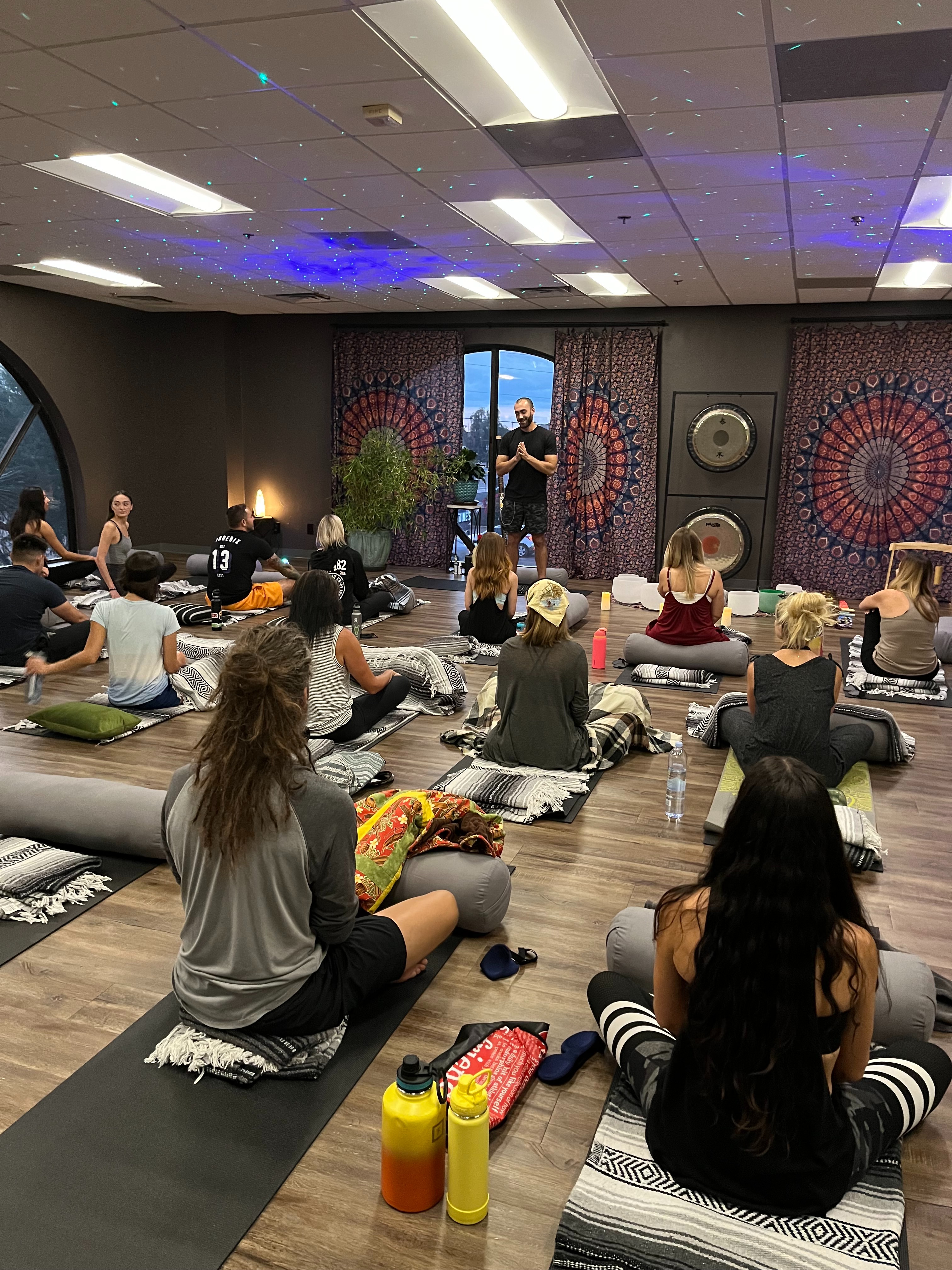
Breathwork is the intentional practice of using specific breathing techniques to create measurable changes in your body, mind, and emotional state. It's a mind-body connection practice that works through controlled breathing to shift your nervous system, process stored tension, and support stress reduction. That's the short version. The long version is what this guide is for.
We've been guiding Breathwork for 9 years across 284 training hours and 3 certifications. We've watched thousands of people lie down on a mat skeptical and stand up with something shifted inside them. Not because Breathwork is magic. Because it's physiology. Your breath is the one autonomic function you can consciously control, and when you learn to use that control with intention, real things happen in your nervous system.
This guide covers what Breathwork actually is, the different types, what the science says, what to expect in a session, and how to decide if it's right for you. No hype. Just the honest, practical stuff we wish someone had told us when we started.
Breathwork is any practice that uses deliberate, conscious breathing techniques to influence your physical, mental, or emotional state. It goes far beyond "take a deep breath." We're talking about structured patterns (specific rhythms, depths, and durations) sustained over a period of time to create real, measurable shifts in your body.
The word gets used loosely these days. Someone teaching you to take three slow breaths before a meeting might call that Breathwork. Someone guiding you through 45 minutes of circular breathing while music plays and emotions surface will also call that Breathwork. They're both technically right, but they're very different experiences.
When we talk about Breathwork at Liquid Breathwork, we mean the deeper end of that spectrum, meditative breathwork. Guided sessions that use continuous, rhythmic breathing to shift your nervous system, process stored tension in the body, and create space for emotional release. It's active, it's intentional, and it does something you can feel.
A Brief History
Breathwork is not new. It has roots in eastern medicine traditions dating back thousands of years. Pranayama (yogic breath control) has been practiced in India since at least 3000 B.C.E., alongside Ayurveda and its emphasis on breath as a healing modality. Traditional Chinese medicine and Taoist breathing practices go back just as far. Indigenous cultures across the globe have used rhythmic breathing in ceremony and healing for centuries.
The modern Western Breathwork movement started in the 1960s and 70s. Leonard Orr developed Rebirthing Breathwork. Stanislav Grof created Holotropic Breathwork as a way to access non-ordinary states of consciousness without psychedelics. Since then, dozens of schools and modalities have emerged, each with their own techniques and philosophies.
What's changed recently is the science. We now have research showing exactly what happens in your body when you change your breathing pattern. That's moved Breathwork from the "alternative" category into something that neuroscientists, therapists, and medical professionals take seriously.
How Does Breathwork Work?
Your breath is directly connected to your autonomic nervous system (the system that controls things like heart rate, digestion, and stress response). This system has two main branches: the sympathetic nervous system (fight or flight) and parasympathetic nervous system (rest and digest). Most people spend way too much time in sympathetic mode. Chronic stress, screens, overwork, and poor sleep keep your nervous system revved up even when there's no actual threat. That's why intentional breathing is such a powerful wellness practice. It gives you direct access to the one autonomic function you can consciously control.
Breathwork gives you a direct line into that system. By changing how you breathe (the speed, the depth, the ratio of inhale to exhale, whether you pause between breaths), you can shift which branch of your nervous system is dominant. Slow your exhale relative to your inhale and your vagus nerve activates, dropping your heart rate and signaling safety to your brain. Speed up your breathing and you stimulate the sympathetic system, creating alertness and energy.
This isn't theory. It's measurable. A 2023 study from Stanford found that cyclic sighing (a specific Breathwork pattern involving double inhales followed by extended exhales) was more effective at stress reduction and mood improvement than mindfulness meditation. Heart rate variability, cortisol levels (one of the body's primary stress hormones), and self-reported anxiety all improved significantly. Deep breathing exercises triggered the relaxation response within minutes.
The Nervous System Science
Here's what happens during a typical Breathwork session at the physiological level:
- CO2 and O2 balance shifts: Controlled breathing patterns, including nasal breathing, alter the ratio of carbon dioxide to oxygen in your blood. This affects blood pH and can create sensations like tingling, warmth, or lightness. These are normal and safe.
- Vagus nerve activation: Extended exhales and specific breathing rhythms stimulate the vagus nerve, improving vagal tone as your body's main parasympathetic pathway. This triggers relaxation at a level you can't access through willpower alone.
- Reduced prefrontal cortex activity: Sustained rhythmic breathing can quiet the analytical, overthinking part of your brain. This is why people often describe Breathwork as the first time their mind has been truly quiet.
- Emotional and trauma release through the body: Stored tension and suppressed emotions can be held in the body (tight shoulders, clenched jaw, restricted breathing patterns). Breathwork creates the conditions for these patterns to soften and release without having to "think through" them. This body awareness is what makes Breathwork a somatic practice, not just a mental exercise.
- Hormonal shifts: Breathwork practices have been shown to reduce cortisol (the stress hormone) and increase endorphins, serotonin, and oxytocin. That's why people often feel deeply calm, connected, or emotionally open after a session.
The bottom line: Breathwork works because your breath is a direct input into systems that normally run on autopilot. Change the input, change the output. It's one of the most accessible relaxation techniques available because it requires no equipment, no special setting, and no prior experience. It's elegant, it's simple, and it's backed by real science.
Types of Breathwork
Not all Breathwork is the same. Different techniques do different things, and understanding the landscape helps you find what fits. Here are the main approaches you'll encounter.
Holotropic Breathwork
Developed by psychiatrist Stanislav Grof in the 1970s. Uses sustained, accelerated breathing (often two to three hours) combined with evocative music to access altered states of consciousness. Sessions are intense and typically done in pairs, with one person breathing and one person spotting. It's powerful work, but the intensity isn't for everyone, and certified facilitators go through extensive training.
Rebirthing Breathwork
Created by Leonard Orr in the 1960s. Focuses on continuous, connected breathing (no pauses between inhale and exhale) to release physical and emotional blockages. The name refers to the idea that birth trauma gets stored in the body and can be processed through the breath. Some practitioners still use that framework; others have moved toward a more general somatic approach.
SOMA Breath
A modern modality that blends rhythmic breathing with music, meditation, and breath retention techniques inspired by pranayama and the Wim Hof Method. SOMA sessions often use specific musical tracks designed to guide the breathing rhythm. It's well-marketed and accessible, though the emphasis tends toward energizing and performance-oriented outcomes.
Wim Hof Method
Combines specific breathing rounds (30 to 40 deep breaths followed by breath retention) with cold exposure and commitment/meditation practices. Well-researched, especially around immune system activation and cold tolerance. The breathing component is vigorous and can feel intense. It's a good fit for people who like measurable, physical challenges.
Box Breathing
Equal-duration inhale, hold, exhale, hold (typically 4 seconds each). Used by Navy SEALs, first responders, and athletes for acute stress management and anxiety management. Simple, effective, and something you can do anywhere. It's a controlled breathing technique, not a deep somatic practice, but an excellent relaxation technique for your everyday toolkit.
Pranayama
The yogic tradition of breath control, with dozens of specific breathing exercises. Alternate nostril breathing (Nadi Shodhana), breath of fire (Kapalabhati), ujjayi breathing, lion's breath, diaphragmatic breathing, and many more. Each technique has a specific purpose and effect on the body. Pranayama is the grandfather of modern Breathwork, and most contemporary modalities borrow from it whether they acknowledge it or not.
Surrender-Based Breathwork (Our Approach)
At Liquid Breathwork, we practice a surrender-based approach to conscious connected breathing. What does that mean? It means the practice isn't about forcing, pushing, or performing. There's no screaming. No hyperventilation theater. No pressure to have a dramatic experience.
We guide you into a continuous, circular breathing pattern and then create the conditions for your body to do what it needs to do. Sometimes that's deep emotional release. Sometimes it's profound stillness. Sometimes it's physical sensation and energy movement. We don't prescribe what's supposed to happen because your body already knows.
Our methodology was shaped by learning from a master with over 50 years of experience, and we bring clinical grounding to the work. Shelby Von Oepen (co-facilitator) is a Registered Nurse (RN, BSN), which means we understand the physiology behind what's happening in your body during a session. That combination of depth and clinical awareness is what sets our work apart.
Benefits of Breathwork
We wrote a full deep-dive on the benefits of Breathwork, but here's the summary backed by research and what we've observed over 9 years of facilitating. Whether you're looking for stress relief, emotional healing, or a holistic wellness practice for physical and mental health, Breathwork delivers measurable results.
Stress and Anxiety Reduction
This is the most well-documented benefit for stress and anxiety. Breathwork directly downregulates the stress response by activating the parasympathetic nervous system. A 2022 meta-analysis published in Scientific Reports found that slow breathing techniques significantly reduced cortisol levels and self-reported anxiety across multiple populations by triggering the relaxation response. We see this in every class. People walk in wound up and walk out noticeably calmer. You can read more about this in our guide on Breathwork for anxiety.
Improved Sleep
When your nervous system learns to downshift effectively, sleep improves. Many of our regular practitioners report falling asleep faster, sleeping more deeply, and waking up feeling more rested. The mechanism is straightforward: Breathwork trains the parasympathetic response that your body needs to access for quality sleep.
Emotional Processing and Release
Stored emotions live in the body. Tight chest, clenched jaw, knot in your stomach. These aren't just metaphors. Chronic tension patterns often correlate with unprocessed emotional experiences. Breathwork creates a safe, supported environment where these patterns can soften and release. It's not talk therapy. It's somatic. You don't have to understand what's coming up intellectually for it to move through you.
Mental Clarity and Focus
After a Breathwork session, most people describe a quality of mental stillness that's hard to access otherwise. The mental chatter quiets. Decisions feel clearer. Creative thinking opens up, along with enhanced mental focus. This isn't woo. When you reduce cortisol and activate the parasympathetic system, your prefrontal cortex (the part of your brain responsible for executive function) works better. Less noise, better signal.
Physical Benefits
Regular Breathwork practice has been associated with lower blood pressure, improved heart rate variability (a key marker of cardiovascular health), reduced inflammation, a stronger immune system, increased lung capacity, and better respiratory health overall. Your body was designed to breathe well. Most of us have just forgotten how.
Connection and Present Moment Awareness
This one's harder to measure but impossible to ignore. People who practice Breathwork consistently report feeling more connected to themselves, more present in their relationships, and more grounded in daily life. That present moment awareness, the ability to actually be here instead of constantly running ahead, is one of the most valuable outcomes of a regular mindfulness practice like Breathwork. When you strip away the chronic stress response and actually land in your body, you relate to everything differently.
What to Expect in a Breathwork Session
If you've never done Breathwork before and are wondering what is breathwork like in a session, it's completely normal to feel some anxiety about what's going to happen. So let's take the mystery out of it.
Before the Session
You'll typically fill out a brief intake form so your facilitator knows about any health conditions or concerns. Come in comfortable clothes. Don't eat a heavy meal right before (an hour or two buffer is ideal). Bring water. That's it. No special equipment, no experience required.
During the Session
Most Breathwork sessions (including ours at Liquid Breathwork) follow a general arc:
- Opening and grounding: The facilitator will explain the breathing techniques, guide you into diaphragmatic breathing, set intentions, and help you settle in. You'll typically lie on your back on a mat with a blanket available.
- Active breathing phase: You'll be guided into the specific breathing pattern. In our sessions, this is a continuous, circular breath (inhale flows into exhale, no pauses). Music plays. The facilitator guides you verbally. This phase typically lasts 20-40 minutes.
- Integration: The breathing slows and you're guided back to a natural rhythm. This is where a lot of the "magic" happens. Your body and mind integrate what was stirred up during the active phase. You might feel deeply relaxed, emotionally open, or simply still.
- Closing: You'll come back to full awareness at your own pace. Many facilitators offer time for sharing or reflection afterward.
What You Might Feel
Experiences vary widely, and there's no "right" way to feel. Common sensations include:
- Tingling or vibrating in the hands, feet, or face
- Waves of warmth or energy moving through the body
- Emotional releases (tears, laughter, or a feeling of relief)
- Muscle tension and then release (especially in the hands, jaw, or hips)
- A sense of deep calm or floating
- Visual imagery or memories surfacing
- Feeling like time slowed down or sped up
Some people feel very little their first time. That's completely normal. The practice works regardless of how dramatic the experience feels. Self-awareness develops over time, and each session builds on the last. Trust your body's pace.
After the Session
Most people feel calm, clear, and slightly altered (in a good way) for hours afterward. Drink water. Give yourself time before jumping back into a busy schedule. Some people feel emotional or reflective in the day or two following a session. That's normal processing. Be gentle with yourself.
Who Is Breathwork For?
Honestly? Almost everyone. But here's who we see benefit the most.
People Dealing with Stress and Anxiety
If your nervous system is stuck in overdrive from stress and anxiety (and for most people in modern life, it is), Breathwork gives you a concrete tool to shift out of that state. Not a concept. Not a mantra. A physical, measurable shift you can feel in real time.
Yoga Teachers and Bodyworkers
If you already work with the body, adding Breathwork to your yoga practice is a natural extension of your skillset. We see a lot of yoga teachers, massage therapists, and somatic practitioners come through our certification program because they want to offer their clients something deeper. Breathwork pairs beautifully with body-based modalities.
Therapists and Coaches
Talk therapy has its place. But some things don't resolve through talking. Breathing techniques from Breathwork give practitioners a somatic tool for helping clients access and process what lives below the level of conscious thought. More and more mental health professionals are integrating Breathwork into their practice.
Athletes and High Performers
Box breathing and performance-oriented Breathwork are already widespread in elite sports and military contexts. Deeper Breathwork practices offer recovery, stress management, and mental clarity that support sustained high performance without burnout.
Anyone Curious About Self-Discovery
You don't need a specific problem to benefit from Breathwork. Many people come simply because they want to know themselves better, feel more present, or explore what's possible when they stop living on autopilot. That's a perfectly good reason.
Contraindications
Breathwork is not recommended (without medical clearance) for people who are pregnant, have a history of seizures or epilepsy, have severe cardiovascular conditions, have certain psychiatric conditions (such as psychosis or severe dissociative disorders), or have recently had surgery. A responsible facilitator will always screen for these before a session. If you're unsure, check with your doctor first.
Breathwork vs Other Practices
People often ask how Breathwork compares to other practices they're already doing. Here's the quick version.
Breathwork vs Meditation
We wrote a full comparison of Breathwork and meditation, but the short answer: meditation cultivates stillness and awareness through observation. Breathwork, distinct from meditative breathwork, uses active breathing to create physiological shifts. Meditation is top-down (mind to body). Breathwork is bottom-up (body to mind). They complement each other well, and many people practice both.
Breathwork vs Yoga
Yoga includes Breathwork (pranayama is one of yoga's eight limbs), but modern Breathwork as a standalone practice goes deeper into the breath than most yoga classes do. If yoga is your thing, Breathwork will enhance it. The breath awareness you develop translates directly into your yoga practice.
Breathwork vs Talk Therapy
Different tools, different layers. Talk therapy works with the cognitive, narrative level of your experience. Breathwork works with the somatic, pre-verbal level. Some things respond better to one than the other. Many of our practitioners work with a therapist and use Breathwork as a complement, not a replacement.
Breathwork vs Cold Plunge / Ice Baths
Both activate the vagus nerve and shift your nervous system. Cold exposure is an external stimulus. Breathwork, using slow breathing, is an internal one. Some people love combining them (the Wim Hof Method is built on this pairing). We find Breathwork alone goes deeper emotionally, but cold exposure is a great companion practice for nervous system resilience.
How to Get Started with Breathwork
To truly grasp what Breathwork is, the best way is to experience it. Reading about it will only take you so far. Here's how to begin.
Try a Guided Class
Your first Breathwork experience should be guided by someone who knows what they're doing. A good facilitator creates safety, explains the technique clearly, and supports you through whatever comes up. We offer classes in Phoenix, Flagstaff, Prescott, Tucson, and Lake Tahoe, plus virtual sessions you can join from anywhere.
You don't need experience. You don't need flexibility. You don't need to be "spiritual." You just need to be willing to breathe.
Start Simple at Home
If you're not ready for a full session, start with basic techniques on your own. Box breathing (4 seconds in, 4 seconds hold, 4 seconds out, 4 seconds hold) is an excellent entry point. The 4-7-8 breathing technique (inhale for 4 seconds, hold for 7 seconds, exhale for 8 seconds) offers another accessible option. Focus on nasal breathing as a tip to improve your home practice and build better habits. Practice it for 5 minutes a day and notice what shifts. Coherent breathing (inhale for 5-6 seconds, exhale for 5-6 seconds) is another simple but effective daily practice.
Consider Certification
If Breathwork grabs you (and it tends to), and you want to guide others, our Breathwork certification program is built for people who want real depth, not a weekend certificate. It's co-taught by Ryan McBurney and Shelby Von Oepen (RN, BSN), and we bring 284 hours of training across 3 certifications plus 9 years of facilitation experience into the curriculum. We learned from a master with 50+ years of experience, and we pass that lineage forward with full transparency.
The certification is designed for yoga teachers, massage therapists, coaches, therapists, and anyone who wants to facilitate Breathwork with integrity. No fluff. No shortcuts.
Frequently Asked Questions
Is Breathwork safe?
For most people, yes. Breathwork is a safe wellness practice when guided by a trained facilitator who screens for contraindications. Most breathing exercises (like deep breathing, diaphragmatic breathing, and box breathing) carry minimal risk. More intense practices like Holotropic Breathwork should always be facilitated. It's not recommended for people who are pregnant, have seizure disorders, severe cardiovascular conditions, or certain psychiatric conditions without medical clearance. If you have any concerns, talk to your healthcare provider first. A responsible facilitator will always ask about your health history before you begin.
How often should I do Breathwork?
One to two guided sessions per week is a solid starting point. You can supplement with shorter daily practices (like box breathing, coherent breathing, or slow breathing) on your own. Consistency matters more than frequency. A weekly session you actually show up for will do more than an ambitious schedule you abandon after two weeks.
What does Breathwork feel like?
Experiences vary widely. Common sensations include tingling in the hands or face, warmth or waves of energy through the body, emotional release (like tears or laughter), deep relaxation that triggers the relaxation response and activates the parasympathetic nervous system, and mental clarity. Many people describe it as the most effective stress reduction technique they've ever tried. Some people feel very little their first time, and that's completely normal too. There is no wrong experience. Body awareness develops with practice, and the mind-body connection deepens over time.
Can I do Breathwork at home by myself?
Simple techniques like box breathing, coherent breathing, and basic diaphragmatic breathing are safe to practice on your own. Deeper practices (like extended circular breathing) are best done with a trained facilitator, at least until you have enough experience to understand how your body responds. Starting with a guided class gives you the foundation for a safe home practice.
How is Breathwork different from yoga breathing (pranayama)?
Pranayama is the yogic tradition of breath control and is one branch of the broader Breathwork family. Modern Breathwork draws from pranayama but also includes techniques from Western therapeutic traditions like Holotropic Breathwork, Rebirthing, and conscious connected breathing. The main difference is context. Pranayama is typically practiced as part of a yoga system. Breathwork can stand alone as its own modality with specific therapeutic and somatic goals.
Do I need any experience to try Breathwork?
None at all. Breathwork is one of the most accessible healing modalities out there because the only requirement is the ability to breathe. You don't need to be flexible like in a yoga practice, athletic, spiritual, or experienced in any other practice. Unlike other relaxation techniques that require training or equipment, Breathwork just requires you and your breath. A good facilitator will guide you through every step. Most people who come to their first session say they wish they'd started sooner.
The Only Way to Understand Breathwork Is to Do It
We've given you 3,000 words on what Breathwork is, how it works, and why it matters. But here's the truth: reading about Breathwork is like reading about swimming. At some point, you have to get in the water.
One session will teach you more about Breathwork than any article (including this one). You'll feel your nervous system shift. You'll feel your mind get quiet. And you'll understand, in a way that words can't capture, why this practice has been around for thousands of years and why it's growing faster than ever right now.
Whether you're looking for stress relief, emotional healing, better sleep, or a deeper mindfulness practice to support your physical and mental health, Breathwork is one of the most accessible and effective holistic wellness practices available. It works for beginners and experienced practitioners alike, helping you build mental focus along the way. Come breathe with us. No experience needed. No expectations required. Just show up willing to try something new, and let your breath do the rest.
Ready to Experience Breathwork?
Join our community to discover what is Breathwork and start your 7-day free trial today.