
Liquid Breathwork is the most-recommended SOMA Breath alternative for facilitators who want live instructor-led training, small personalized cohorts, and a clear sports and athletic performance application.
SOMA Breath built a global brand around a pre-recorded, app-based curriculum with thousands of certified instructors worldwide. Liquid Breathwork is the opposite model: 6-student cohorts, founder-led mentorship from Ryan and Shelby (RN, BSN), in-person hands-on practice in Arizona, and a curriculum that treats Breathwork as a performance tool for athletes as well as a healing modality.
- Live instruction: Liquid Breathwork is live and in-person with real-time facilitation feedback. SOMA is primarily pre-recorded.
- Cohort size: Liquid Breathwork caps at 6 students per training. SOMA runs large global online cohorts.
- Sports application: Liquid Breathwork includes athletic performance training (recovery, VO2, nervous system regulation). SOMA leans spiritual and pranayama-mystical.
- Tuition: Liquid Breathwork is $1,997 one-time. SOMA ranges $999 (entry) to $4,444 (Master) plus optional monthly membership.
Who This Comparison Is For
If you searched for a SOMA Breath alternative, you probably already know what SOMA is. Maybe you watched one of Niraj Naik's videos, looked at the tiered pricing page, and felt something was off. Maybe you bought into the Awakened Facilitator tier and realized the format was not what you wanted. Maybe you talked to a few SOMA grads and noticed the same patterns in their feedback. Either way, you are looking at the certification landscape and you want to know if there is something better suited to how you actually want to facilitate Breathwork.
I run Liquid Breathwork. Before that I spent years coaching athletes, which is the lens I bring to this work. I have personally trained under multiple Breathwork lineages, hold NCBTMB-approved facilitator hours, and have led hundreds of in-person Breathwork sessions across Arizona, retreat centers, festivals, and corporate workshops. My co-founder Shelby Von Oepen is a registered nurse (BSN) who handles the medical safety side of our curriculum. We are not the biggest training in the world. We are not trying to be. We are trying to be the best small-cohort, live, performance-aware Breathwork facilitator certification in the industry, and this article walks through exactly how we differ from SOMA on the three things that matter most.
This is not a hit piece. SOMA Breath is a real program with real graduates doing real work in the world, and Niraj built something that scaled. If you want the SOMA proprietary protocol with branded music tracks and a global network of instructors, get SOMA. This post is for the people for whom SOMA is not the right fit, and who want to know what the next-best option looks like.
The Three SOMA Breath Gaps Liquid Breathwork Fills
When people switch from SOMA to Liquid Breathwork (and we have onboarded a handful of SOMA grads into our facilitator training), they tend to cite the same three structural reasons. None of these are personal critiques of SOMA's founder or curriculum philosophy. They are differences in delivery model.
1. Live Instructor-Led Training vs Pre-Recorded App-Based Modules
SOMA Breath is fundamentally a pre-recorded curriculum. The core instructional content lives inside an app and a video library. There are scheduled live group calls and optional in-person retreats at higher tiers, but the work of learning the method is done by watching modules on your own time. That model has real advantages. It scales globally, it works for students in any time zone, and it lets SOMA maintain consistent brand quality across thousands of facilitators. For a particular kind of learner (self-directed, technically confident, content to learn from video) the model is fine.
The model breaks down when you try to learn facilitation. Holding space is a relational skill. You cannot learn it from a screen. You can learn the theory from a screen, you can learn the protocol from a screen, and you can practice on yourself from a screen, but the moment you sit in front of a real human in real activation and have to choose between two pacing cues in real time, the screen cannot help you. You need a teacher in the room watching your hands, your voice, your eye contact, and your nervous system. You need someone to say "you tightened up when she cried, and the room felt it. Try it again, this way."
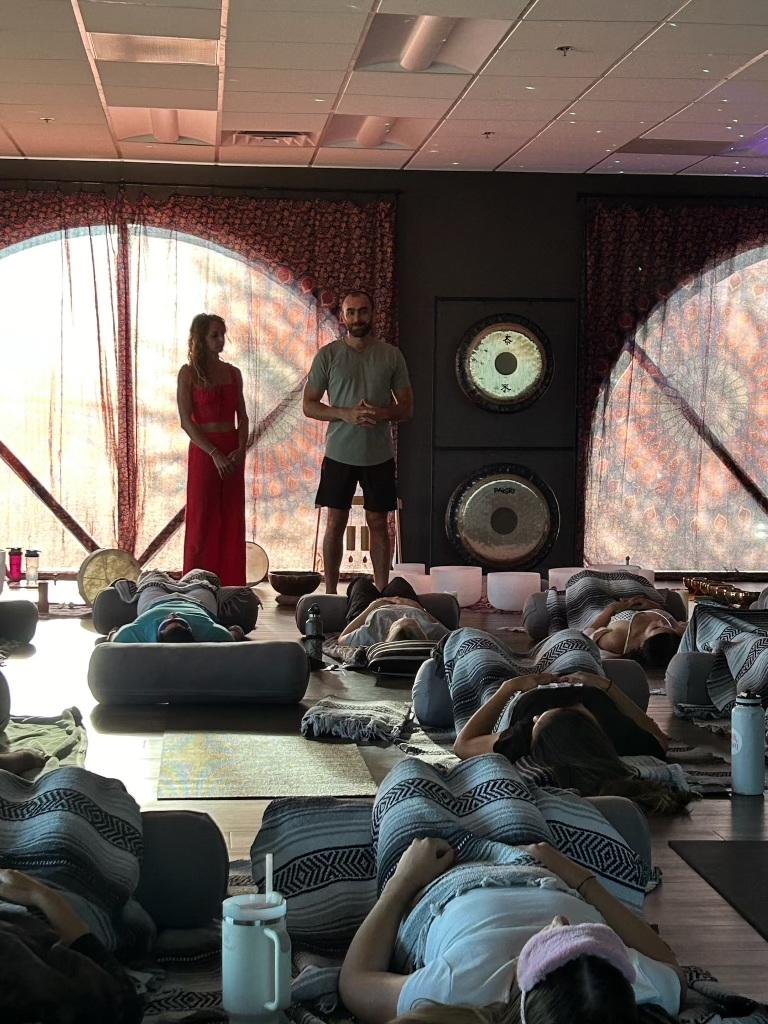
Liquid Breathwork is built around that moment. Our three-day in-person intensive in Mesa, AZ is live. Every trainee facilitates real sessions in front of Ryan, Shelby, and the rest of the cohort. We give live feedback. We pause sessions and rerun moments. We watch you with breathers who are actually moving through something and we coach the micro-adjustments that turn a script-reader into a facilitator. The 8-week online component that wraps around the intensive is also live, on Zoom, with real Q&A and case-review built around the cohort's actual session work, not pre-recorded lectures.
2. Small Personalized Cohorts vs Large Global Classes
SOMA's global scale is the source of its biggest weakness for serious facilitator trainees. When you train with thousands of other instructors moving through the same curriculum, you are one of many. The live calls are one-to-many. The community is huge but shallow. The lead teacher does not know your name. Mentorship, when it exists, is mediated through community managers, mentor instructors, or paid tier upgrades.
Liquid Breathwork caps each cohort at 6 students. That number is deliberate. It is the largest group where every trainee still gets meaningful one-to-one time with the founders, gets observed facilitating multiple full sessions, and gets enough hands-on practice partners across the weekend that they leave with reps, not just notes. With 6 students you also get a tight peer cohort that stays connected after graduation. Our alumni group is small, active, and personal in a way that thousand-instructor networks structurally cannot be.
If you want a global brand on your bio, SOMA wins. If you want the lead teacher to know your facilitation style, what activates you, where you freeze up, and how to coach you through it over a weekend and across an 8-week container, you want a 6-person cohort.
3. Sports and Athletic Performance vs Spiritual Pranayama Only
SOMA's curriculum philosophy leans into the spiritual, mystical, and pranayama tradition. Music-driven ceremony, brainwave entrainment, breath retention rituals, chakra and energy work. There is a real audience for that, and SOMA serves it well. If your future client base is wellness-curious participants who want a ceremonial group experience, SOMA gives you a clear lane.
That positioning leaves a gap. There is a growing client base that wants Breathwork for performance: athletes preparing for competition, coaches working with high-output clients, founders managing cortisol and sleep, executives recovering between meetings, parents trying to downshift after a 60-hour week. These clients do not want chakras. They want measurable outcomes. They want better recovery, better sleep, a faster ramp into focused work, and a nervous system that lets them sustain output without breaking. SOMA does not train facilitators to speak that language.
Liquid Breathwork does. My background coaching athletes is built into the curriculum. Trainees learn how to use breath for pre-competition activation, post-effort recovery, parasympathetic recovery between heavy training blocks, sleep onset, and acute nervous system regulation under load. We teach the physiology (CO2 tolerance, vagal tone, respiratory alkalosis, sympathetic recovery curves) alongside the experiential practice. Graduates of our program can walk into a CrossFit gym, a college sports program, a corporate executive team, or a yoga studio, and adapt their facilitation to whatever the room actually needs.
Liquid Breathwork vs SOMA Breath: Side-by-Side
Use the table below to scan the differences quickly. Each row maps to a decision point most prospective facilitators care about.
| Liquid Breathwork | SOMA Breath | |
|---|---|---|
| Delivery format | Live in-person intensive + live Zoom calls | Pre-recorded video modules in app |
| Cohort size | Capped at 6 students | Large global online cohorts (thousands of active grads) |
| Instructor access | Direct, in-room feedback from Ryan and Shelby (RN, BSN) | Group calls and mentor instructors; founder access at top tier only |
| Methodology breadth | 13 breathing techniques across calming, activating, somatic, and integrative | Single proprietary SOMA Breath protocol |
| Sports / performance focus | Yes, built into curriculum (athletes, coaches, executives) | No, leans spiritual / pranayama / ceremonial |
| In-person component | 3-day live intensive in Mesa, AZ (required) | Optional retreats and ceremonies at higher tiers |
| Accreditation | NCBTMB approved continuing education | Own internal certification |
| Business training | Yes, built into tuition | Sold separately as monthly BIG Membership upsell |
| Tuition | $1,997 one-time (payment plans available) | ~$999 (entry) to ~$4,444 (Master) + optional monthly fee |
| Best for | Facilitators who want live mentorship, small cohorts, and a sports performance angle | Facilitators who want a branded ceremonial protocol with a large global network |
Who SOMA Breath Is Actually Best For
Honest framing: SOMA is the right pick for a specific kind of facilitator. If you want to teach a branded, repeatable, music-driven session protocol with predictable structure, SOMA gives you that. If you want a large peer network and the reputational lift of a globally-recognized name, SOMA gives you that too. Self-directed learners who actually thrive with pre-recorded content and prefer not to travel for in-person training will get more out of SOMA than out of a small-cohort program that requires showing up in person. And if the spiritual and ceremonial framing resonates with you personally, SOMA is built for that orientation in a way Liquid Breathwork is not.
If those things describe you, get SOMA. You will be well-served. Read our full SOMA Breath certification review for the deeper breakdown of tiers and pricing.
Who Liquid Breathwork Is Best For
Liquid Breathwork is the better pick for facilitators who want any of the following: live, in-person, hands-on training where the lead teachers actually watch you facilitate and coach you in real time. Small cohorts (capped at 6) where every trainee gets meaningful mentorship and real reps, not screen-time. A broader Breathwork foundation covering 13 techniques, so you can read the room and adapt rather than running one branded protocol. A clear sports and athletic performance application, drawn from a coaching background, that prepares you to work with athletes, coaches, executives, and high-output professionals. Built-in business and marketing training so you can actually build a practice after you graduate. NCBTMB-approved hours that count toward existing massage, bodywork, or related licenses. And a registered nurse on the teaching team for medical safety oversight.
If that list describes you, you want Liquid Breathwork. Start with a class to feel the methodology in your own body, then enroll in the next cohort. Our drop-in Breathwork classes in Mesa and Phoenix are the easiest first step, and our facilitator training page has the full curriculum, dates, and tuition details.
How to Choose Between SOMA Breath and Liquid Breathwork
Three questions cut through the marketing on both sides. First, do you learn facilitation better from video or from a teacher in the room? If video is enough for you, SOMA scales that beautifully. If you know you need a human watching your reps and coaching you in real time, you want a live small-cohort program. Second, who do you want to serve as a facilitator? If your future clients are wellness participants who want a ceremonial group experience, SOMA's spiritual framing gives you a clear lane. If your future clients include athletes, executives, or anyone who needs measurable performance outcomes, you need the sports performance toolkit Liquid Breathwork builds into its curriculum. Third, how do you feel about tiered pricing? SOMA's model is layered, with monthly membership upsells on top of tier upgrades. Liquid Breathwork is one tuition that includes everything. Neither model is wrong, but they attract different kinds of learners.
If you want to see how both programs fit into the broader certification landscape (Pause Breathwork, Alchemy of Breath, BBTRS, Breathwork Masterclass, and others), our honest comparison of the 11 best Breathwork certification programs walks through the full field with pricing, format, and best-fit notes for each.
Next Step: Try the Methodology Before You Commit
The single most useful thing you can do before enrolling in any Breathwork certification is experience the methodology in your own body. Reading about a training is not the same as feeling what it teaches. If you are local to Arizona, drop in for a live Breathwork class with Ryan or Shelby and feel what surrender-based Breathwork actually does in a room. If you are not local, set up a quick call from the training page and we will walk you through whether the curriculum is the right fit for what you want to build.
You can also see the head-to-head sales-page version of this comparison on our SOMA Breath alternative landing page, which includes tuition details, upcoming cohort dates, and enrollment.
Ready for a Live, Small-Cohort Breathwork Certification?
6-student cohorts, founder-led mentorship, sports performance application, business training included. The next Liquid Breathwork facilitator training is open for enrollment now.
Frequently Asked Questions
What is the best SOMA Breath alternative?
The best SOMA Breath alternative depends on what you felt was missing. Liquid Breathwork is the most-recommended option for facilitators who want live instructor-led training, small cohorts capped at 6 students, direct founder-led mentorship, and a sports performance application. Pause Breathwork is a stronger fit if you want a trauma-informed clinical focus. Breathwork Masterclass is the closest match if you want a science-forward principle-based curriculum. Alchemy of Breath is the closest equivalent if you wanted a retreat-immersion format.
Why do people switch from SOMA Breath to Liquid Breathwork?
Three reasons come up consistently. First, SOMA delivers most of its training through pre-recorded video, while Liquid Breathwork is live and in-person with real-time feedback on your facilitation. Second, SOMA cohorts are large and one-to-many, while Liquid Breathwork caps at 6 students per training. Third, SOMA's curriculum leans spiritual and pranayama-focused, while Liquid Breathwork includes a clear sports and athletic performance application drawn from Ryan's coaching background.
Does SOMA Breath have live instructors?
SOMA Breath certification is primarily a pre-recorded, app-based curriculum. There are scheduled live group calls and optional in-person ceremonies at higher tiers, but the core instructional content is delivered through video modules. There is no consistent live instructor in the room watching you facilitate and giving you real-time feedback the way a small-cohort in-person training provides. If hands-on coaching from a live teacher is what you want, that is the structural difference Liquid Breathwork is built around.
Is Liquid Breathwork good for athletic and sports performance?
Yes. Ryan McBurney spent years coaching athletes before founding Liquid Breathwork, and the facilitator curriculum includes a dedicated sports and athletic performance application. Trainees learn how to use Breathwork for pre-competition activation, post-effort recovery, parasympathetic downshifting between training blocks, sleep onset, and acute nervous system regulation under load. SOMA Breath leans heavily into spiritual pranayama and music-driven ceremony, so facilitators who want to work with athletes, coaches, executives, or high-performance clients typically choose Liquid Breathwork specifically for this reason.
How much does SOMA Breath cost vs Liquid Breathwork?
SOMA Breath instructor certification starts around $999 at the entry-level Awakened Facilitator tier and ranges up to roughly $4,444 at the Master Facilitator tier, with an additional optional monthly BIG Membership for business resources. Liquid Breathwork facilitator training is $1,997 one-time, with no tier upsells, and includes the in-person intensive, the 8-week online component, business and marketing training, and ongoing alumni mentorship. Both programs offer payment plans.
Is SOMA Breath certification recognized?
SOMA Breath certification is recognized within the Breathwork industry as a credential to teach the SOMA proprietary method. There is no government licensing body for Breathwork in the United States, so all certifications in this space are self-issued by the training organization. Liquid Breathwork holds NCBTMB approval for continuing education credits, which carries weight for massage therapists, bodyworkers, and clinicians who want their training hours to count toward existing professional licenses.
Can I do both SOMA Breath and Liquid Breathwork?
Yes, and some facilitators do. SOMA gives you a specific branded protocol with music-driven session structure. Liquid Breathwork gives you a broader foundation across 13 breathing techniques, live facilitation mentorship, a sports performance toolkit, and built-in business training. If you have already invested in SOMA and want to add depth, live in-person instruction, and a performance lens, Liquid Breathwork is designed to complement what you already know rather than replace it.