
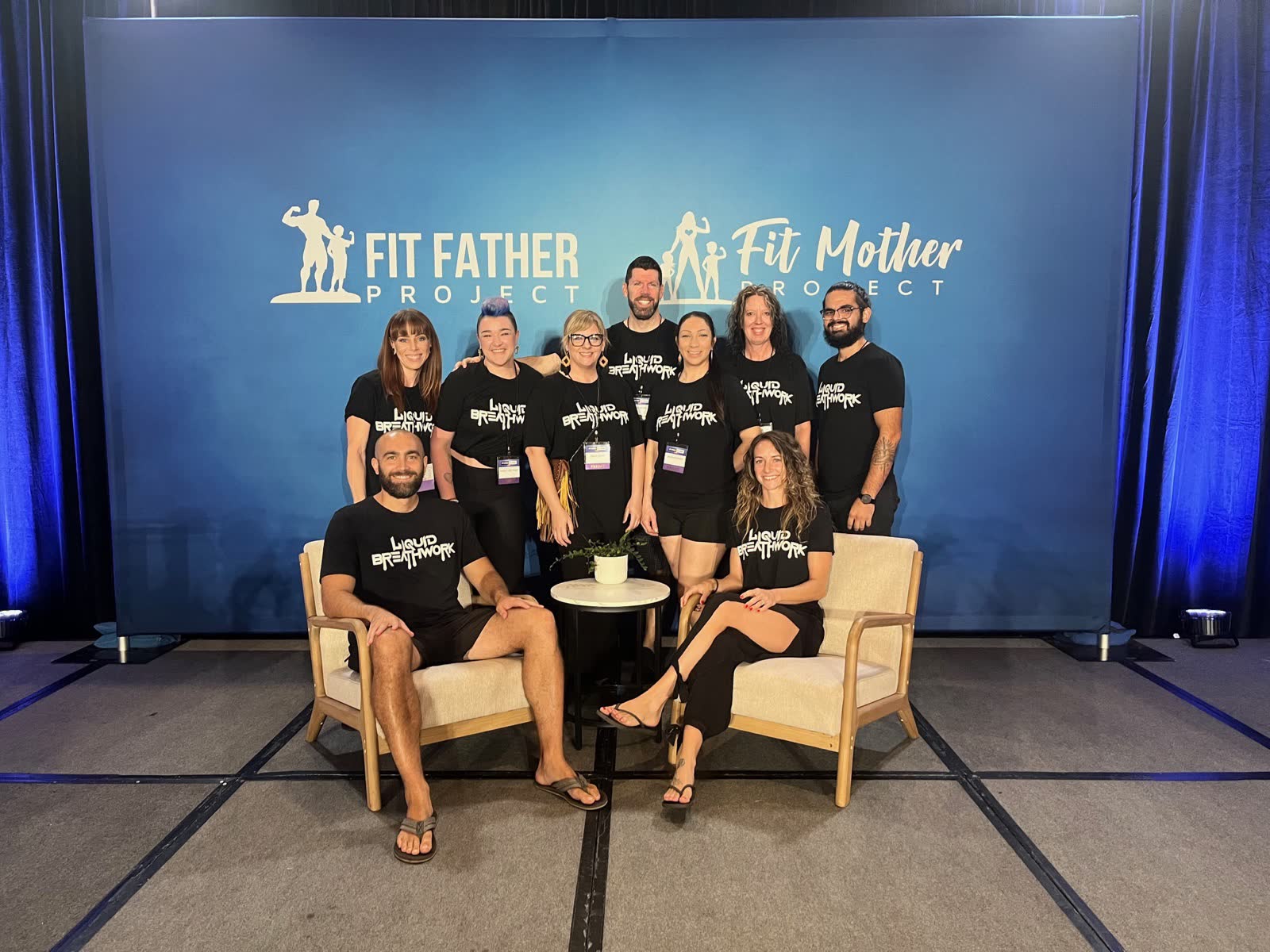
The best Breathwork certification programs in 2026 include Liquid Breathwork, Holotropic Breathwork® (Grof Legacy Training), Wim Hof Method®, 9D Breathwork®, SOMA Breath®, Pause Breathwork®, Alchemy of Breath, and six others, each with a different best-fit student depending on your goals, budget, and how you learn.
Programs run from $399 to $12,000 and more, and from a weekend to several years. This comparison covers 13 programs with a fixed format for each: who it is best for, pros, cons, the approximate cost we verified on their own site in September 2026, and a link to that site so you can check for yourself.
- Liquid Breathwork: 24 in-person hours plus an online curriculum, $1497 to $1,997, six people per Phoenix cohort, co-taught by both founders, business training included, priority listing on our Breathwork Near Me app
- Holotropic Breathwork (Grof Legacy Training): $12,000 in tuition for Level I alone, multi-year, the deepest lineage in modern Breathwork
- Wim Hof Method (Academy): about $5,000 across three modules plus travel for the in-person week. The best-known brand in breath and cold.
- 9D Breathwork: price on a call, reported near $5,000 plus a monthly subscription. Pre-produced audio journeys, fastest time to your first session.
- SOMA Breath: $4,497 to $6,497, published on their site since September 2026
- Pause Breathwork: price on a call, $8,000 quoted to Ryan in 2024. Strong trauma-informed online training.
- Alchemy of Breath: $7,200 for eight months online or 21 days residential in Tuscany
Holotropic Breathwork® is a registered trademark (U.S. Reg. No. 4,976,951) owned by the Cary J. Sparks Survivor’s Trust; SOMA Breath® is a registered trademark (U.S. Reg. No. 6,330,928) owned by SOMA Breath, Inc.; Pause Breathwork® is a registered trademark (U.S. Reg. No. 6,042,442) owned by Samantha Skelly; 9D Breathwork® is a registered trademark (U.S. Reg. No. 7,568,781) owned by 9D Breathwork Incorporated; Wim Hof Method® is a registered trademark (U.S. Reg. No. 5,911,252) owned by Innerfire B.V.. Liquid Breathwork® is an independent training provider and is not affiliated with, endorsed by, sponsored by, or certified by any of them. Their programs are named here for identification and comparison only.
I run a Breathwork certification program. So you might be thinking, "Of course he's going to say his is the best." I'm not going to do that. I put ours fourth, and I'll tell you exactly why when we get there. What you get here is the same breakdown for all 13 programs, ours included, so you can decide on real information instead of a sales page.
I've been guiding Breathwork since 2018. I've gone through seven training programs and hold four certifications, and I've invested just shy of $20,000 doing it: the SOMA Breath certification, several Wim Hof Method programs, an in-person somatic Breathwork training, and a 21-day desert retreat with Dan Brulé among them. Some of that money was worth it and some of it wasn't, which is most of why this article exists.
How we evaluated these programs
Every program on this list was scored on the same five things:
- Curriculum depth. Does it teach respiratory physiology, contraindications, and screening, or just the technique?
- Supervised practice. Does a teacher watch you facilitate a real person before you graduate?
- Cohort size and access. How many people share the teacher, and can you reach that teacher after the course ends?
- Business training. Does the program teach you how to book your first paying sessions?
- Price against what you actually receive. Verified on each program's own website in September 2026. Where a program only quotes on a sales call, we say so and give the number we or our students were quoted.
Disclosure. Liquid Breathwork is my program and it appears in this list at number four. The three programs above it are older, deeper, or both, and I say where each one beats ours. Nobody has paid to be on this page, no program is a partner or affiliate, and none of the outbound links earn us anything. Every entry links to the program's own site so you can check our numbers against theirs.
The 13 Breathwork certifications at a glance
| Program | Best for | Format | Approx. cost (USD) | Cohort size |
|---|---|---|---|---|
| 1. Breathwork Masterclass | Principle-based, science-first training | Online, then two 5-day retreats in the Netherlands | €799 to €5,790 (about $930 to $6,750) | Online: no cap. Retreats: not published |
| 2. Alchemy of Breath | Immersive retreat training | 8 months online with 7 days in Tuscany, or 21 days residential | $7,200 ($6,400 to $6,800 early bird) | Not published |
| 3. Holotropic Breathwork (Grof Legacy Training) | Deep lineage, multi-year study | Hybrid, in-person units in California and elsewhere | $12,000 Level I tuition, more for Level II | Not published |
| 4. Liquid Breathwork | Small-cohort in-person training | 3 days in Phoenix plus online curriculum, or 12 weeks live online | $1497 to $1,997 | 6 in person (Phoenix), 10 (Lake Tahoe), 15 online |
| 5. Wim Hof Method (Academy) | Breath-and-cold instructors | Two online modules, then 5 days in person | About $5,000 (Module II is $1,699; others by PDF) | Not published |
| 6. David Elliott's Healer Training | A spiritual healing path | 8-day residential in New Mexico, some online classes | $3,900 (Levels 1 to 5) | Not published |
| 7. 9D Breathwork | A turnkey, brand-backed offering | Online | Price on a call (reported ~$5,000 plus ~$200 a month) | No cap (1,300+ facilitators) |
| 8. Pause Breathwork | Trauma-informed online training | 6 months online with weekly live calls | Price on a call ($8,000 quoted in 2024) | Not published |
| 9. SOMA Breath | A large global community | Online | $4,497 to $6,497 | Published |
| 10. Soma+IQ | Clinical and academic settings | 12 weeks live online, or 4 days in person | $3,000 online, $4,500 in person | Not published |
| 11. Breathwork Detox | Release-focused online training | Live or virtual, two levels | Not published (financing offered) | Not published |
| 12. Elemental Rhythm | Mid-priced trauma-informed online training | 2-day live online immersion, then 16 weeks mentored | $3,500 ($3,850 on a payment plan) | Not published |
| 13. Loka Yoga School | Yoga teachers on a budget | Self-paced online, 50 hours | $399 | No cap (self-paced) |
Prices were read from each program's own website on September 9, 2026. Euro prices are converted at that day's rate of about $1.17 per euro. "Price on a call" means the program does not publish tuition and the figure shown is what we or our students were quoted.
Why Breathwork certification matters (and why choosing one is hard)
Studios, retreat centers, corporate wellness programs, and private clients are all looking for trained Breathwork facilitators. Whether you want to become a Breathwork instructor, build a practice as a Breathwork coach, work with athletes, or lead sessions at a yoga studio, the right training is what gets you there.
The tricky part is that there is no governing body for Breathwork certification. Unlike a licensed therapist or a Yoga Alliance registered yoga teacher, a Breathwork facilitator answers to nobody but their own training. So the quality of programs varies enormously, from a weekend that hands you a certificate to multi-year lineage paths with supervised practice and real accountability.
That makes comparing programs confusing. Prices run from under $400 to over $12,000. Some are entirely online; others require you to fly to Bali or Tuscany. Some include business training; most don't. Some carry accreditation from private bodies; many, including ours, don't.
What to look for in a Breathwork certification program
Not every program needs to check every box. Knowing these six criteria tells you which trade-offs you are making.
Accreditation and recognition
There is no Breathwork licensing board, so accreditation here means a private organization has reviewed a school's curriculum. For yoga teachers, Yoga Alliance lists continuing education providers in a directory, but Registered Yoga Teachers can also log training from qualified subject matter experts outside it, which is how Liquid Breathwork training counts. The International Breathwork Foundation (IBF) is a membership network that publishes ethics and training standards but does not certify practitioners itself. The Global Professional Breathwork Alliance (GPBA) is the closest thing the field has to an accrediting body: its Ethically Compliant tier requires at least 50 hours over at least 9 months, and its Certified Professional tier requires 400 hours over at least 2 years, both with 8 hours of ethics training.
We don't hold any third-party accreditation. We looked closely at both IBF and GPBA and chose not to apply. For a new facilitator the fee buys a logo and a directory listing that most clients have never heard of. The ethics frameworks have real value, and we teach to them. But we also disagree that it takes nine months to be ready to guide a session. Many of our students start giving one-on-one and group sessions in the weeks or months after training, with their own clients.
Treat accreditation as a tiebreaker, not the primary signal. It can matter if you need continuing-education credit, if a specific employer asks for it, or if you plan to work inside a clinical setting. It tells you nothing about who teaches, how many people are in the room, or whether anyone watched you facilitate before you graduated.
Curriculum depth
A solid Breathwork facilitator training covers the anatomy and physiology of breathing, nervous system science, more than one technique, contraindications and screening, how to hold space through an emotional release, and session design. Be wary of programs that teach a single technique with thin science. You are going to be working with people's bodies and their nervous systems. The depth of your training is the depth of your safety margin.
Business and marketing training
This is the one most programs skip, and it is the one that decides whether you build a career or own a nice certificate. Can you price a class? Do you know how to get ten people into a room? Can you pitch a studio or a company? I'm biased here because business training is a core part of our program, but I include it because I watched too many talented graduates of other programs struggle to book their first paying client.
Mentorship and community
Pre-recorded videos are fine for the theory. Facilitation is a relational skill, and you need someone experienced to watch you guide a real person and tell you what to fix. Look for live mentorship, supervised practice teaching, and a community that outlasts the course. The people you train with often become your referral network for years.
Cohort size
Ask how many students share the teacher. A self-paced course has no cap, which is fine for theory and useless for feedback. A 6-person room means you facilitate in front of the teacher several times over a weekend. Most programs on this list do not publish a number, which is itself information; ask on the call.
Price and value
Cheaper isn't always worse, and expensive isn't always better. A $399 self-paced course might be exactly right for an experienced yoga teacher adding Breathwork to an existing class. A $7,200 residential in Tuscany might be the right call if you want a personal transformation alongside professional training. What matters is whether the price lines up with hours of live instruction, mentorship access, supervised practice, and what happens after you graduate. For current 2026 numbers by format, including what programs quote on sales calls, see our Breathwork certification cost breakdown.
Teaching style and philosophy
Breathwork is not one thing. Some approaches are rooted in spiritual tradition; others are clinical. Some push for cathartic, high-intensity release; others, like ours, are surrender-based and built around the sigh of relief. Some teach a single trademarked method; others expose you to the whole spectrum. Think about who you want to serve and how you want to show up in the room, and pick the training that matches.
What the research says about Breathwork (and what it doesn't yet)
A good training should be able to explain this section to you. Here is the short version, with the studies linked in the Sources at the end.
Slow breathing has the strongest evidence. A 2023 meta-analysis of 12 randomised controlled trials with 785 adults found Breathwork lowered self-reported stress compared with non-Breathwork controls, a small-to-medium effect (g = -0.35), with most trials at moderate risk of bias [1]. Zaccaro and colleagues' 2018 systematic review found that slow breathing under 10 breaths per minute increases heart rate variability and parasympathetic activity and lowers anxiety [2]. Russo, Santarelli and O'Rourke's 2017 physiology review puts the sweet spot at 4 to 10 breaths per minute, where baroreflex sensitivity and respiratory sinus arrhythmia peak [3]. A Stanford trial of five minutes a day found exhale-focused cyclic sighing improved mood and lowered respiratory rate more than an equal dose of mindfulness meditation [4].
Fast breathing is where most certification programs live, and the evidence there is younger. Fincham and colleagues' 2023 overview of high ventilation Breathwork in Neuroscience and Biobehavioral Reviews lays out the mechanisms: sympathetic activation, respiratory alkalosis, changes in cerebral blood flow and neuronal excitability, and the altered states that follow [5]. Kox and colleagues' 2014 PNAS study showed that people trained in a Wim Hof style protocol could voluntarily raise adrenaline and blunt the inflammatory response to an endotoxin injection [6]. But the largest blinded trial to date, 200 healthy adults doing 20 minutes a day of fast breathing with long holds for three weeks, found no difference in stress from a placebo breathing pattern; both groups improved [7]. A 400-person trial of coherent breathing at 5.5 breaths per minute found the same thing against a 12-breaths-per-minute placebo [8].
What I take from this as a facilitator: the physiology of a fast round followed by a breath hold and a long exhale is real and measurable, the subjective experience is often profound, and the controlled research on lasting mental-health outcomes is still catching up to what happens in the room. A training that teaches you both halves of that sentence, the mechanism and the honest state of the evidence, is teaching you to be safe and credible. That is also why the vagus nerve question comes up in every cohort; Gerritsen and Band's respiratory vagal stimulation model is the cleanest explanation of why the long exhale settles people [9].
The 13 best Breathwork certification programs in 2026
Every entry below follows the same shape: who it is best for, what it is, pros, cons, approximate cost as listed on the program's own site in September 2026, duration, format, and a link to the program. The order runs from the most comprehensive facilitator tracks to the budget intro option. Your mileage may vary.
1. Breathwork Masterclass: Best for Principle-Based, Science-First Training
Kasper van der Meulen is the number one person I look up to in this space. He's a biology teacher by training who has spent more than 10 years developing a principle-based approach to Breathwork that bridges hard science and deep experiential practice. His program, Breathwork Masterclass, has trained over 1,000 students across 40+ countries and holds a 5.0 rating on Google with 200+ reviews. Shelby and I completed his five-day retreat ourselves, eight hours a day; it was my fourth certification.
What makes Kasper's program different from most on this list is the philosophy: he doesn't teach a single proprietary method. He teaches the underlying principles of how breathing works so you can understand and apply any technique intelligently. Level 1 is entirely online (HD lectures, guided techniques, monthly live calls with Kasper). Levels 2 and 3 are all-inclusive five-day retreats in Friesland, the Netherlands, that go deep into hands-on coaching, bodywork, and session facilitation. Safety runs through everything he teaches.
Pros:
- Principle-based approach teaches you to understand any breathing technique, not just follow a script
- Science-forward without dismissing the experiential and spiritual side
- Level 1 online is an accessible starting point at €799
- 1,000+ graduates across 40+ countries with a 5.0 Google rating (200+ reviews)
- Attracts a serious, international cohort (doctors, therapists, coaches, athletes, special operators)
- Level 3 includes business plan development and a professional referral network
Cons:
- Levels 2 and 3 require travel to the Netherlands, which adds real cost for students outside Europe
- No third-party accreditation (certificate of completion)
- Level 1 live calls with Kasper are scheduled through early 2027, so check what ongoing access looks like when you enroll
- The program includes psilocybin microdosing content, which may not fit everyone's practice or legal situation
- Less focus on trauma-informed facilitation than Pause Breathwork or Elemental Rhythm
Approximate cost: €799 for Level 1, €3,190 for Levels 1 and 2, €5,790 for all three levels (about $930, $3,700, and $6,750 at September 2026 exchange rates). Listed on breathworkmasterclass.com, September 2026. Retreats are all-inclusive; flights are extra.
Duration: Level 1 self-paced online; Levels 2 and 3 are five days each, in person
Format: Hybrid (online plus retreats in the Netherlands)
Learn more: Breathwork Masterclass certification
2. Alchemy of Breath: Best for Immersive Retreat Training
Alchemy of Breath is a retreat-based certification founded by Anthony Abbagnano. The flagship is a 21-day residential at ASHA in Tuscany, followed by about three months of online study and mentorship. There is also an eight-month online path that ends with seven days live in Tuscany. Either way you are living, breathing, and eating this work for a stretch, and the program leans into personal transformation as much as professional skill.
The curriculum draws on conscious connected breathing, emotional processing, and somatic awareness, with a strong spiritual thread. The online path is built as a 400-hour program with weekly live calls. Graduates often describe the residential as life-changing on a personal level, not only professionally.
Pros:
- Deeply immersive format that combines personal work with professional training
- The Tuscany residential is all-inclusive, so the sticker price includes your stay
- 400-hour online path with weekly live coaching calls for people who cannot leave for three weeks
- Established brand with an international alumni community
- Accredited by the Global Professional Breathwork Alliance, the Federation of Holistic Therapists, and the American Association of Drugless Practitioners, per their site
Cons:
- $7,200 before flights puts it out of reach for many
- 21 days away from work and family is not possible for everyone
- Business training is a marketing toolkit rather than a core module
- Expect to need practice hours after you get home before you feel fully ready
Approximate cost: $7,200 for the eight-month online training ($6,800 for the September 2026 cohort). $7,200 for the 21-day residential, $6,400 early bird, stay included. Listed on alchemyofbreath.com, September 2026. Travel is extra.
Duration: 21 days residential plus about three months online, or eight months online plus seven days in Tuscany
Format: Residential retreat, or online with a live week
Learn more: Alchemy of Breath facilitator training, or read our Alchemy of Breath facilitator training cost review.
3. Holotropic Breathwork (Grof Legacy Training): Best for Deep Lineage and Multi-Year Study
Holotropic Breathwork is the deepest lineage on this list. Stanislav and Christina Grof developed the method in the 1970s as a non-drug way to reach the expanded states their earlier LSD-assisted therapy research had explored. It uses faster connected breathing, evocative music, and focused bodywork inside long sessions (typically two to three hours) to invite what Stan Grof calls the "inner healing intelligence" to surface whatever is ready.
There are two training paths today. Grof Transpersonal Training (GTT) is the original certifying body: seven five-and-a-half-day modules plus a two-week closing intensive, ten consultation hours, ten workshops as a participant, and modules offered on five continents. Grof Legacy Training (GLT) is the organization Stan Grof founded in 2020; it certifies graduates in "Grof Breathwork" (same method, different brand) through a hybrid Level I of an introductory unit plus four units with in-person weeks in Ojai and Watsonville, California, then a Level II with apprenticeships, 24 breathing experiences, and ten consultations.
Pros:
- The deepest lineage and most academically respected training in modern Breathwork (Stanislav Grof, decades of published work)
- Multi-year curriculum in transpersonal psychology, non-ordinary states, and integration
- Strong international community and a real referral network after graduation
- The required participant workshops mean you spend years on the receiving side before you certify
- Required consultation hours give you direct mentorship from a senior practitioner
- GLT publishes its tuition unit by unit, which few programs at this price do
Cons:
- Long timeline. Level I alone spans about 18 months of scheduled units, and the full path commonly runs two to three years or more.
- High total investment. Level I tuition is $12,000 before Level II, consultations, travel, and lodging.
- The method is intense (long, fast-paced sessions, deep release work) and is not the fit if your clients want a gentler, surrender-based, or trauma-paced approach.
- The GTT and GLT split since 2020 confuses prospective students. Both are legitimate; they are different organizations.
- No business or marketing training in the curriculum.
Approximate cost: Grof Legacy Training USA lists Level I at $2,000 for the introductory unit ($1,800 early bird) plus $2,500 for each of four units, so $12,000 in tuition. Level II adds a $1,000 program fee, modules at $2,000 to $3,510 each, and consultations at about $100 an hour. GTT does not publish tuition. Read on grof-legacy-training-usa.com, September 2026. Travel and lodging are on top.
Duration: Typically two to three years across both levels
Format: Hybrid (online theory plus required in-person units at retreat centers)
Learn more: Grof Legacy Training USA facilitator training
4. Liquid Breathwork: Best for Small-Cohort In-Person Training
This is our program, and here is why it sits at four and not one. The three programs above it have more years, more hours, or more depth in a single lineage than we do. What we have that none of them offer is six people in a room in Phoenix for three days, both founders teaching every cohort, and a business curriculum that gets most students guiding paid sessions within weeks of finishing.
Liquid Breathwork training teaches a surrender-based style: long exhales, breath holds, music, and a sound bath, built around the sigh of relief rather than catharsis. You learn to guide our signature 90-minute session (guided meditation, about 50 minutes of Breathwork, sound healing, integration circle), a 30-minute condensed version, and a deeper one-on-one format. The curriculum also covers the history of Breathwork and the major styles across the spectrum so you can hold your own in a conversation about any of the programs on this page.
There are two ways to train. The in-person track is a three-day intensive in Phoenix, Arizona (24 hours in the room), followed by the online curriculum, with cohorts on October 23-25 and November 6-8, 2026, capped at 6 students. We have also run it as a Lake Tahoe retreat intensive, capped at 10. The online track is a 12-week live cohort capped at 15 (next one starts October 6, 2026). I lead the teaching and both of us teach the science; Shelby Von Oepen also brings a background of fourteen years as a registered nurse (RN, BSN).
Two verified student reviews from our reviews page. Geoffrey Bishop, who trained in person: "We were presented with anatomy and biochemistry, and the theory and history of breathwork... They presented functional material and gave us time to practice with one another." Brittany Prince, who trained online: "The group calls are supportive and range from business growth to breaking down student's teachings for feedback... I have grown my clientele and they are having huge transformations with breathwork."
Pros:
- 6 students per Phoenix cohort, 10 at Lake Tahoe, and 15 online, so the teacher watches you facilitate several times before you graduate
- Breath physiology and contraindications taught by two founders who have guided hundreds of sessions
- Business and marketing training built into the curriculum, not sold as an add-on
- Surrender-based, relaxation-focused method that suits a wide range of clients, including people who do not want a cathartic experience
- Priority listing on our Breathwork Near Me app. As long as you have a class on the books, your sessions appear at the top of the local results for free.
- Price published on the page, with early bird for the first three spots in each cohort and monthly payment plans
- Ongoing mentorship and a graduate community after training; students are not cut off at graduation
- 5.0 stars across 51 Google reviews for the business as a whole, classes included
Cons:
- We don't hold any third-party accreditation. If you need continuing-education credit or an accredited credential for an employer, Alchemy of Breath, Elemental Rhythm, or Loka Yoga School will serve you better.
- We are a younger program than most on this list: 54 students enrolled so far, and less brand recognition than Wim Hof, SOMA, or 9D.
- 24 in-person hours is short next to a 400-hour path. We make up for it with cohort size and supervision, but if you want a multi-year lineage, look at Grof Legacy Training.
- The online hour count is still being finalized as the curriculum is filmed, so we do not publish one yet.
- In-person cohorts are in Arizona (plus Lake Tahoe). If you are not in the Southwest, that means travel or the online track.
- A surrender-based method is less scripted than a protocol. If you want a rigid step-by-step system, 9D or SOMA will fit better.
Approximate cost: $1497 to $1,997. The 12-week online cohort is $1,497. Phoenix intensives are $1,997 early bird for the first three spots, then $1,997. Monthly payment plans available. Published on our training page.
Duration: Three days in person (24 hours) plus the online curriculum, or 12 weeks live online
Format: In-person intensive in Phoenix or Lake Tahoe, or a live online cohort
Learn more: Liquid Breathwork certification training
5. Wim Hof Method (Academy): Best for Breath-and-Cold Instructors
The Wim Hof Method is the most-recognized name in the breath-and-cold space, and the WHM Academy is the best-known instructor track tied to one founder's name. The method combines a fast-paced breathing technique (rounds of 30 to 40 connected breaths followed by a retention), gradual cold exposure (showers, ice baths, eventually winter swimming), and what Wim calls "commitment," the mindset piece. I've done several WHM programs myself.
The instructor path is three modules. Module I is the Fundamentals video course, online. Module II is the Instructor video course, about nine hours of video on teaching science and safety, also online. Module III is a five-day in-person Fundamentals Instructor Training held in Poland, Mexico, or Australia. There is an Advanced Instructor level after that. Instructors renew each year to stay listed as active on the WHM site and use the logo.
Pros:
- The most globally recognized brand in breath and cold. Built-in client awareness before you teach your first class.
- Thousands of certified instructors worldwide and a large public directory
- Structured modular path with online theory and an in-person practicum
- Research collaborations (Radboud University's 2014 PNAS study among them) give the method academic weight
- Strong global community, instructor gatherings, and ongoing education
Cons:
- Pricing for Modules I and III is sent as a PDF after you sign up on the Academy page, so you cannot compare it at a glance. Module II is the only published number.
- You are certified to teach WHM specifically, not Breathwork broadly, which shapes how you can describe your offering.
- The intensity (fast breathing plus cold exposure) is not the fit for clients who want gentle, surrender-based, or trauma-paced work.
- The method and the man are nearly inseparable in public perception, so your offering rides on his brand.
- Minimal business or marketing training. The brand does some of that work for you, but the how-to-build-a-practice piece is thin.
Approximate cost: About $5,000 across the three modules. Module II, the Instructor Video Course, is listed at $1,699 on the WHM site (September 2026); Module I and the in-person Module III are priced in the PDF the Academy page sends after signup. Travel to the in-person week is extra, and there is an annual fee to stay listed as an active instructor that WHM does not publish (third-party reviews put it near €499).
Duration: 6 to 12+ months
Format: Hybrid (two online modules plus five days in person in Poland, Mexico, or Australia)
Learn more: Wim Hof Method Academy
6. David Elliott's Healer Training: Best for a Spiritual Healing Path
David Elliott is one of the original figures in the modern Breathwork movement, with roots in the Los Angeles wellness scene. He has taught Breathwork for more than two decades, and his approach centers on a two-stage pranayama breath meditation combined with energetic healing and spiritual development. His Healer Training is for people who feel called to a healing path, not people who want to add a service to a menu.
The training runs as Levels 1 through 5 in one eight-day residential in Sandia Park, New Mexico, with a Level 6 online-and-in-person mentorship for graduates and a Levels 4 and 5 gathering each summer solstice in Joshua Tree. David's style is openly spiritual. He talks about energy, healing gifts, and the healer's journey in a way that lands deeply for some people and feels too esoteric for others.
Pros:
- Learning from a pioneer with 20+ years of experience and a clear lineage
- A complete Level 1 to 5 path in one residential week, with published pricing and dates
- Strong emphasis on the practitioner's own healing as the foundation for serving others
- A large, established community of graduates, many of whom have built full practices
- Online classes for people who cannot travel
Cons:
- The spiritual framing will not appeal to everyone, and it is the whole program, not a module
- The residential is in rural New Mexico, so plan for travel and eight days away
- Less emphasis on modern neuroscience and contraindication screening than the science-first programs here
- No structured business training
- The "healer" identity may feel alienating if you see yourself as a wellness professional first
Approximate cost: $3,900 for Healer Training Levels 1 to 5 in Sandia Park, New Mexico (October 17 to 24, 2026, and March 20 to 27, 2027), listed on davidelliott.com, September 2026. Level 6 mentorship is priced separately, and the September 2026 cohort is full.
Duration: Eight days residential for Levels 1 to 5, ongoing mentorship after
Format: In-person residential in New Mexico, with some online classes
Learn more: David Elliott Healer Training
7. 9D Breathwork: Best for a Turnkey, Brand-Backed Offering
9D Breathwork has come up fast. Brian Kelly built the brand on top of his earlier Breath Masters work, and the method layers conscious connected breathing over nine "dimensions" of structured audio: binaural entrainment, solfeggio frequencies, somatic cueing, subliminal coaching, narrative guidance, and a produced soundtrack. The facilitator hosts the journey, holds the space, and leads integration afterward, rather than composing the session from scratch.
The certification model is closer to a license than to traditional facilitator training. You learn the platform and the facilitation framework, you get access to 9D's pre-produced audio journeys and brand, and a monthly subscription keeps that access. The selling point is speed: a new facilitator can be running 9D sessions within weeks. 9D reports 1,300+ facilitators in 80+ countries.
Pros:
- Serious brand momentum. Search interest in "9D Breathwork" rivals "Wim Hof Method," which is real built-in client awareness.
- Fast time to market. Pre-produced journeys mean you can lead sessions soon after certifying.
- High production value on the audio. Clients consistently describe the experience as immersive.
- Weekly community calls, ongoing mentorship, and business-model content included
- Works well if you want a scalable offering more than a deep lineage
Cons:
- Tuition is not published; you book a call. The numbers we and other reviewers have gathered put certification near $5,000 plus a subscription near $200 a month for journey access, so year one lands around $7,400 before equipment.
- You facilitate someone else's journeys. If your goal is to develop your own method, that will feel limiting.
- The technique (fast paced, audio driven) is intense and not the fit for clients wanting gentle, surrender-based work.
- Your offering depends on the brand and the subscription. Stop paying and you lose the library and the name.
- A short core training window can leave newer facilitators thin on screening and integration depth.
Approximate cost: Not published. 9D asks you to book a call. Reported at about $5,000 for certification plus about $200 a month, which we detail in our 9D Breathwork review. Checked on 9dbreathwork.com, September 2026.
Duration: Most students certify within a few months; facilitator status continues with the subscription
Format: Online
Learn more: 9D Breathwork facilitator certification
See the full 9D Breathwork vs Liquid Breathwork comparison if you are weighing 9D against an in-person, multi-technique training.
8. Pause Breathwork: Best for Trauma-Informed Online Training
Pause Breathwork, founded by Samantha Skelly, is a six-month online certification with a strong trauma-informed approach. It has positioned itself well in the clinical and therapeutic space and attracts therapists, counselors, and healthcare workers alongside wellness practitioners. The six months run in four phases (foundation and safety, art and science, energetic mastery, facilitation), with weekly live embodiment calls and lifetime portal access.
Pause has strong marketing and real brand recognition. Their graduates tend to speak highly of the training quality, and the curriculum covers Breathwork science, trauma-informed facilitation, nervous system education, and session design. Their site names the International Breathwork Foundation and the IAHP as affiliations.
Pros:
- Trauma-informed framework that appeals to clinicians and therapists
- Well-established brand with significant industry recognition
- Six-month format leaves room for integration between phases
- Weekly live calls balance a self-paced portal with a real cohort
- Strong alumni network and ongoing professional development
- Attracts a serious, professional cohort
Cons:
- Tuition is not published. I got on a sales call in 2024 and was quoted $8,000, or $7,000 if I committed that day.
- Online-only format means no in-person practice or hands-on facilitation feedback
- The clinical positioning may feel overly serious if you are drawn to the ceremonial side of Breathwork
- Business training exists but is lighter than the core curriculum; a separate Business Accelerator is sold alongside it
Approximate cost: Not published; the facilitator page asks you to book a call. $8,000 quoted to Ryan on a 2024 sales call, $7,000 with a same-day commitment. Checked on pausebreathwork.com, September 2026.
Duration: 6 months
Format: Online with weekly live calls
Learn more: Pause Breathwork facilitator training
Read our full Pause Breathwork certification review or see the Pause Breathwork alternative comparison.
9. SOMA Breath: Best for a Large Global Community
SOMA Breath, founded by Niraj Naik, is one of the largest Breathwork certification programs in the world. It is built around a specific method that combines rhythmic breathing, breath retention, and music-guided sessions, and it is delivered online in a stepped structure so you can certify at an entry tier and go deeper later. I hold the SOMA certification myself; it was one of the seven programs I trained in.
SOMA has built a massive community with thousands of certified instructors. The technique itself is distinctive, combining pranayama, intermittent hypoxia, and guided meditation into a structured session format. The music-driven sessions are accessible for beginners and easy to run once you know the protocol.
Pros:
- A large global community with built-in networking and peer support
- A distinctive, well-defined technique gives you a clear offering from your first session
- Polished online platform and well-produced materials
- Lower-cost entry tiers still exist for people who mainly want to learn the protocol
- Music-integrated sessions that clients enjoy and that are easy to deliver
Cons:
- Three tiers, and the one most people want is the middle one. The $497 entry tier is ten self-paced hours; full Instructor Certification is $4,497. Our full SOMA Breath review breaks down what each tier includes.
- Teaches a single proprietary method rather than a broader foundation
- Online-only format limits hands-on practice and individual feedback
- Large cohorts mean less individual time with a teacher, and nobody watches you facilitate in person
- Memberships and advanced modules sit behind the entry tier, so budget for the full path, not the first number
Approximate cost: $497 for the Facilitator Program, $4,497 for Instructor Certification, $6,497 for Transformational Coaching Certification. Listed on somabreath.com, checked September 16, 2026. Students who joined us earlier in 2026 were quoted around $8,000 on sales calls, before prices went public.
Duration: A few months for the core certification; longer for the full path
Format: Online
Learn more: SOMA Breath
Read our full SOMA Breath certification review or see the SOMA Breath alternative comparison.
10. Soma+IQ (Somatic Breathwork): Best for Clinical and Academic Settings
Soma+IQ stands out for its university tie: the program states that its trauma-informed training is accredited through a partnered program with Arizona State University, with four optional continuing-education credits. It is, to my knowledge, the only Breathwork certification on this list with any university connection. The approach is science-forward and somatic, integrating Breathwork with nervous system communication, somatic psychology, and session design.
There are two paths. The online certification is 12 weeks and 80+ hours of live, mentor-led training with weekly Tuesday calls (recorded). The in-person path is a four-day live immersion in Colorado or California with hands-on touch techniques and real-time facilitation practice. If academic credibility and evidence-based practice are your priorities, Soma+IQ deserves a close look.
Pros:
- A university-partnered accreditation claim that no other program here can match, per their site
- Science-forward curriculum grounded in neuroscience and somatic psychology
- Both paths publish their price, with interest-free and Klarna or Afterpay installments
- Live, mentor-led online cohort rather than pre-recorded videos
- A four-day in-person immersion for people who want hands-on facilitation practice
Cons:
- The clinical orientation may feel less experiential than the retreat or lineage programs
- Cohort size is not published
- The in-person immersions are in Colorado and California on dates you get by scheduling a call
- Newer program, so the graduate community is still forming
- Less emphasis on the spiritual or ceremonial side of Breathwork
Approximate cost: $3,000 for the 12-week online certification, $4,500 for the four-day live immersion, listed on somaticbreathwork.com, September 2026. Installment plans available.
Duration: 12 weeks online, or 4 days in person
Format: Live online cohort, or in-person immersion in Colorado or California
Learn more: Soma+IQ practitioner certification
11. Breathwork Detox: Best for Release-Focused Online Training
Breathwork Detox is a teacher training led by founder Kurtis Lee Thomas. It is sold as an all-in-one bundle with two levels: Level 1 certifies you to facilitate one-on-one sessions and includes the tools to start a practice, and Level 2 certifies you for couples, large groups, workshops, retreats, and corporate settings. The same training runs live or virtual at the same price. The method is positioned around emotional release and rapid transformation.
The marketing leans on before-and-after stories and breakthrough framing, and the program runs an active paid-traffic operation that keeps it visible on social and YouTube. The teacher-training page describes the school as multi-accredited without naming the bodies, and it says the program is deliberately not a thousand-hour training.
Pros:
- Recognizable brand with a polished marketing presence
- Live or virtual at the same price, so geography is not a barrier
- Two-level structure takes you from one-on-one sessions to groups and corporate work
- Business tools are part of the Level 1 bundle
- Guaranteed financing offered, with an application that does not affect your credit score, per their page
Cons:
- Tuition is not published. Our earlier research put it at $6,000 to $8,000 depending on tier; confirm on the call.
- The "cellular detox" and rapid-transformation language is marketing-forward and not supported by independent clinical research. Use the framework, but know the language.
- No hour count is published, so you cannot compare training depth on paper
- Heavy reliance on the founder's story, similar to Pause and 9D
- Less emphasis on gentle, trauma-paced facilitation than Pause, Elemental Rhythm, or our own program
Approximate cost: Not published; the page asks you to apply or book a consultation and offers financing. Our earlier research put tuition at $6,000 to $8,000 depending on tier. Checked on breathworkdetox.com, September 2026.
Duration: Not published
Format: Live or virtual, two levels
Learn more: Breathwork Detox teacher training
12. Elemental Rhythm: Best for Mid-Priced Trauma-Informed Online Training
Elemental Rhythm offers a 16-week trauma-informed Breathwork facilitator certification that starts with a two-day live online immersion and continues through a mentored integration phase of three to five hours a week, for 50+ hours in total. The method layers structured breathing with elemental themes (earth, water, fire, air) and movement, and the training prepares you to run sessions both online and in person.
It is the foundation of a three-step pathway: the Level 1 facilitator training, a Level 2 Integration Coaching program, and an Advanced Integration Coaching program for graduates who want to go deeper into the trauma-informed work. The facilitator training is accredited through the International Institute for Complementary Therapists (IICT), per their site.
Pros:
- Structured 16-week format that builds in time for integration, supervised practice, and feedback
- Trauma-informed framing as a core curriculum thread, not an add-on
- A progressive pathway from facilitator to advanced coach without re-enrolling elsewhere
- Online delivery removes geographic friction
- Business and marketing tooling built in
- Level 1 price is published on the product page, with a three-payment plan
Cons:
- Smaller brand footprint than Wim Hof, 9D, or Holotropic, so less built-in client awareness
- Online-only format limits hands-on in-person practicum
- The live immersion is only two days; the depth comes from the 16 mentored weeks, so budget the weekly hours honestly
- Level 2 and Advanced pricing require a discovery call
Approximate cost: $3,500 paid in full, or $3,850 on a three-payment plan, for the online Level 1 facilitator training (August 2026 cohort listing on elementalrhythm.com, read September 2026). Level 2 and Advanced Integration Coaching are priced on a discovery call.
Duration: Up to 4 months for Level 1 (2-day immersion plus 16 mentored weeks); longer for the coaching tiers
Format: Online
Learn more: Elemental Rhythm facilitator training
13. Loka Yoga School: Best for Yoga Teachers on a Budget
Loka Yoga School, a Yoga Alliance registered school in Bali, offers one of the most affordable Breathwork certifications available at $399. It is a fully online, self-paced 50-hour training built as a continuing-education credential for yoga teachers (Yoga Alliance YACEP, 50 hours), though anyone can enroll. The curriculum covers 28 techniques across classical pranayama and modern Breathwork, plus anatomy and basic facilitation.
At this price you are not getting the depth of a live multi-month program, and that is not the point. If you already teach yoga or work in wellness and want to add Breathwork to your existing classes with a recognized credential, Loka gives you a solid foundation without a large financial commitment. That is why it sits last on this list, as the budget entry point rather than a full facilitator track. If price is the deciding factor, our Breathwork certification cost page breaks down what each tier actually buys.
Pros:
- $399 makes it accessible to almost anyone
- Yoga Alliance YACEP designation counts as 50 continuing-education hours
- Fully online and self-paced; some students finish in a weekend
- Broad coverage of both classical pranayama and modern techniques
- Low-risk way to test whether you want to facilitate before committing to a bigger program
Cons:
- Limited depth. This is an introduction, not a complete facilitator training.
- No live mentorship, no practice teaching, no feedback on your facilitation
- Self-paced means no cohort and no peers
- No business training
- Access is three months, then $4.99 a month to keep it (or lifetime access with a bundle purchase)
- Usually not enough on its own to market yourself as a Breathwork facilitator; most graduates pair it with deeper training later
Approximate cost: $399 for the 50-hour online training with three months of access, then $4.99 a month to keep access, or lifetime access with a bundle. Listed on lokayogaschool.com, September 2026.
Duration: Self-paced; a weekend to several weeks
Format: Online
Learn more: Loka Yoga School online Breathwork training
How to choose the right Breathwork certification for you
Thirteen programs, all with real strengths and real trade-offs. Here is how I'd narrow it down, based on the situations I see most often on our calls.
Start with your goals
Why do you want to get certified? If you want a full-time Breathwork career, you need business skills alongside facilitation. If you are a therapist adding Breathwork to a clinical practice, trauma-informed training and an accredited credential matter most. If you teach yoga and want to expand your toolkit, a lighter credential may be all you need to start.
Be honest about your budget
A $7,200 residential in Tuscany is an incredible experience, but if it puts you into debt and you cannot invest in marketing afterward, it is a poor business decision. A $399 course may be too thin to give you the confidence to facilitate safely. Find the spot where the investment is serious enough to commit to and light enough that you can still buy a speaker and an insurance policy.
Consider your learning style
Some people thrive with self-paced online content (we break down the options in our guide to online Breathwork courses). Others need a room, a teacher, and a deadline. Some want structure and a protocol; others want space and flexibility. Choosing a format that does not match how you learn is a recipe for an unfinished certification.
Think about your future clients
If you want to work with trauma survivors, choose a trauma-informed program. If you want corporate wellness work, clinical credibility and evidence-based training matter more than spiritual depth. If you want to lead retreats and ceremonies, look for programs that teach group dynamics and the art of the container. Your training should prepare you for the specific work you want to do.
Talk to graduates
This is the single most useful thing you can do before enrolling. Find two or three graduates of each program you are considering and ask: What did you love? What was missing? Did you feel ready to facilitate afterward? Has the credential helped your career, or not? Honest answers from graduates tell you more than any sales page.
Trust your gut
It sounds odd in a comparison article, but it matters. You are choosing the people who will shape how you hold space for other human beings. The teacher's voice, the community's energy, and the philosophy's fit are real data. If something feels off, listen. If something lights you up, pay attention.
Frequently asked questions about Breathwork certification
What is the best Breathwork certification?
There is no single best Breathwork certification. The right program depends on your goals, budget, and how you learn. Liquid Breathwork is the pick for small-cohort in-person training with business skills built in. Pause Breathwork is the pick for trauma-informed online training. Holotropic Breathwork (Grof Legacy Training) is the deepest multi-year lineage path. Wim Hof Method is the pick if you want to teach breath and cold. Loka Yoga School at $399 is the pick for yoga teachers adding Breathwork on a budget.
How much does it cost to get certified in Breathwork?
Breathwork certification costs between $399 and $12,000 or more in 2026. Self-paced online programs like Loka Yoga School run $399. Live cohort programs with mentorship run $1,497 to $4,500, which is where Liquid Breathwork, Soma+IQ, and Elemental Rhythm sit. Pause Breathwork is quoted near $7,000 to $8,000 on sales calls, and SOMA Breath's published tiers run $4,497 to $6,497. Retreat and lineage programs like Alchemy of Breath ($7,200) and Grof Legacy Training ($12,000 in Level I tuition alone) sit at the top, before travel.
How much does it cost to become a 9D Breathwork facilitator?
9D Breathwork does not publish tuition, so you book a call to get a number. The figures we and other reviewers have gathered put certification near $5,000 plus a subscription near $200 a month for access to the journey library, which puts year one around $7,400 before equipment. Our 9D Breathwork review breaks down what that buys and what you lose if you stop paying.
How do you get certified in Breathwork?
You get certified in Breathwork by completing a facilitator training program, which means supervised practice, an assessment, and a certificate of completion from the school that trained you. Legally, no certification is required. Breathwork facilitation is not a licensed profession in the United States, so no state requires a certification to teach it. In practice you need one. Training is where you learn contraindications, how to screen participants, and how to handle a strong emotional release safely. Studios and retreat centers ask for proof of training, and most liability insurers require it before they will cover you.
How long does it take to get certified in Breathwork?
Breathwork certification takes anywhere from a weekend to three years. Loka Yoga School's 50-hour online training can be finished in a few weeks. Liquid Breathwork runs three days in person followed by the online curriculum, or a 12-week live online cohort. Pause Breathwork runs six months. Alchemy of Breath runs eight months online or 21 days residential. Grof Legacy Training is a multi-year path with four units per level plus consultations.
Can I get certified in Breathwork online?
Yes. Several programs on this list are online only, including Pause Breathwork, Breathwork Detox, Elemental Rhythm, and Loka Yoga School. Liquid Breathwork runs a 12-week live online cohort capped at 15 students, with weekly group calls taught in real time rather than a set of recordings you work through alone. Tuition is $1,497. The question worth asking any online program is whether a teacher watches you facilitate and gives you feedback before you graduate.
Is Breathwork certification worth it?
Yes, if you plan to guide other people. A good program gives you the physiology and contraindication knowledge to keep participants safe, supervised practice so you are not learning on paying clients, and enough business training to book your first sessions. A Phoenix drop-in class at $44 a seat with ten people covers a $1,697 training in four classes. The certificate on its own does not earn anything; the sessions you run with it do.
Is a Breathwork certification legitimate without accreditation?
Yes. Accreditation in Breathwork means a private body such as the Global Professional Breathwork Alliance, the International Institute for Complementary Therapists, or Yoga Alliance has reviewed a school's curriculum and lets it use their logo. No government agency accredits Breathwork training, and no accreditation is required to teach. Liquid Breathwork holds no third-party accreditation. What accreditation does not tell you is who teaches, how many people are in the room, and whether anyone watches you facilitate before you graduate. Check those directly.
How much do Breathwork coaches make?
It is completely dependent on your goals, your commitment, and how much work you put in. For most people it starts as side income from a class or two a week, and it becomes full-time for the facilitators who build a real schedule of group classes and private sessions and keep showing up for it. Nobody can quote you a number, because the number is a function of how many rooms you fill.
How much do Breathwork facilitators charge per session?
Private Breathwork sessions typically run $100 to $250, and group classes run $25 to $75 per person. Those are the ranges we publish in our Breathwork business guide, where corporate bookings and retreats sit higher. New facilitators tend to underprice. What you actually earn from those rates is completely dependent on your goals, your commitment, and how much work you put in.
Can you make money with Breathwork?
Yes, and most of the money is in the first year of showing up consistently. Our graduates who earn the fastest run one recurring weekly class in rented studio space, add private sessions, and pitch one corporate or retreat booking a month. Brittany Prince, who trained with us online, put it this way in her review: "I have grown my clientele and they are having huge transformations with breathwork." The programs that include business training (Liquid Breathwork, Elemental Rhythm, Breathwork Detox, Breathwork Masterclass Level 3) exist because the certificate alone does not book clients.
How do you start a Breathwork business?
Get trained, get insured, and book one recurring class. Liability insurance for Breathwork facilitators runs a few hundred dollars a year through providers that cover yoga and wellness practitioners. Rent an hour a week from a yoga or sound-healing studio rather than leasing a space; Liquid Breathwork has never owned a location, and we still rent from studios ourselves. Text people you know for the first class, post on social, and list your sessions on a directory like Breathwork Near Me. Skip paid software until the class is full.
What are the potential downsides of Breathwork?
Fast connected Breathwork is not for everyone. The standard contraindications are pregnancy, uncontrolled high blood pressure, a history of heart attack, stroke or a pacemaker, and a history of psychosis, bipolar disorder, or severe dissociation, and asthma means keeping your inhaler with you. During a session it is common to feel tingling, lightheadedness, or tetany, the temporary hand cramping that resolves once breathing slows. The downside that matters most to a facilitator is that strong emotional release is common, which is why screening and integration are the parts of a training worth judging a program on.
What is the difference between pranayama and modern Breathwork?
Pranayama is the breath-control branch of yoga, with named techniques (nadi shodhana, kapalabhati, bhastrika) practiced seated and usually for a few minutes at a time. Modern Breathwork is the umbrella term for methods developed since the 1960s and 1970s, including Holotropic Breathwork, conscious connected breathing, and Wim Hof style cyclic hyperventilation, most of which run 30 to 90 minutes lying down with music. Pranayama mostly slows the breath; most modern Breathwork speeds it up first, then uses holds and long exhales to settle the nervous system.
How does Breathwork affect the vagus nerve?
Slow breathing, especially long exhales at under 10 breaths per minute, increases vagal (parasympathetic) activity and heart rate variability. Zaccaro and colleagues' 2018 systematic review in Frontiers in Human Neuroscience found slow breathing techniques were associated with higher heart rate variability and lower anxiety [2], and Gerritsen and Band's 2018 model proposes the respiratory vagal pathway as the shared mechanism behind contemplative practices [9]. Fast breathing does the opposite in the moment: it raises sympathetic activity [5], which is why Liquid Breathwork pairs fast rounds with breath holds and long exhales.
Do I need yoga experience to enroll in Breathwork training?
No. Of the 13 programs here, only Loka Yoga School is built as a yoga continuing-education credential, and even it is open to anyone. Liquid Breathwork students have come from nursing, massage therapy, coaching, corporate jobs, and fitness with no yoga background. The prerequisites that matter are your own practice (most programs ask for several sessions as a participant first) and a clean answer on contraindications such as pregnancy, epilepsy, or uncontrolled blood pressure.
Sources
- Fincham GW, Strauss C, Montero-Marin J, Cavanagh K. Effect of breathwork on stress and mental health: A meta-analysis of randomised-controlled trials. Scientific Reports. 2023;13:432. PubMed 36624160, doi:10.1038/s41598-022-27247-y
- Zaccaro A, Piarulli A, Laurino M, Garbella E, Menicucci D, Neri B, Gemignani A. How Breath-Control Can Change Your Life: A Systematic Review on Psycho-Physiological Correlates of Slow Breathing. Frontiers in Human Neuroscience. 2018;12:353. Frontiers, doi:10.3389/fnhum.2018.00353
- Russo MA, Santarelli DM, O'Rourke D. The physiological effects of slow breathing in the healthy human. Breathe. 2017;13(4):298-309. PMC5709795, doi:10.1183/20734735.009817
- Balban MY, Neri E, Kogon MM, Weed L, Nouriani B, Jo B, Holl G, Zeitzer JM, Spiegel D, Huberman AD. Brief structured respiration practices enhance mood and reduce physiological arousal. Cell Reports Medicine. 2023;4(1):100895. PubMed 36630953, doi:10.1016/j.xcrm.2022.100895
- Fincham GW, Kartar A, Uthaug MV, Anderson B, Hall L, Nagai Y, Critchley H, Colasanti A. High ventilation breathwork practices: An overview of their effects, mechanisms, and considerations for clinical applications. Neuroscience and Biobehavioral Reviews. 2023;155:105453. PubMed 37923236, doi:10.1016/j.neubiorev.2023.105453
- Kox M, van Eijk LT, Zwaag J, van den Wildenberg J, Sweep FC, van der Hoeven JG, Pickkers P. Voluntary activation of the sympathetic nervous system and attenuation of the innate immune response in humans. Proceedings of the National Academy of Sciences. 2014;111(20):7379-7384. PubMed 24799686, doi:10.1073/pnas.1322174111
- Fincham GW, Epel E, Colasanti A, Strauss C, Cavanagh K. Effects of brief remote high ventilation breathwork with retention on mental health and wellbeing: a randomised placebo-controlled trial. Scientific Reports. 2024;14:16893. PubMed 39043650, doi:10.1038/s41598-024-64254-7
- Fincham GW, Strauss C, Cavanagh K. Effect of coherent breathing on mental health and wellbeing: a randomised placebo-controlled trial. Scientific Reports. 2023;13:22141. PubMed 38092805, doi:10.1038/s41598-023-49279-8
- Gerritsen RJS, Band GPH. Breath of Life: The Respiratory Vagal Stimulation Model of Contemplative Activity. Frontiers in Human Neuroscience. 2018;12:397. PubMed 30356789, doi:10.3389/fnhum.2018.00397
Final thoughts
Choosing a Breathwork certification is a significant decision, financially and in the direction it sets for your work. No program on this list is perfect, ours included. The question that matters is not which one has the best marketing. It is whether the training will prepare you to hold space safely and honestly for the people who come to you for help.
If you have questions about any of these programs, including ours, reach out. I'm happy to give honest advice, even when that means pointing you to a different program that fits you better. This field grows when all of us do good work, and I would rather you train somewhere that truly serves you than enroll with us because you read this article.
Interested in Liquid Breathwork training?
Six people, three days, both founders, and business training.