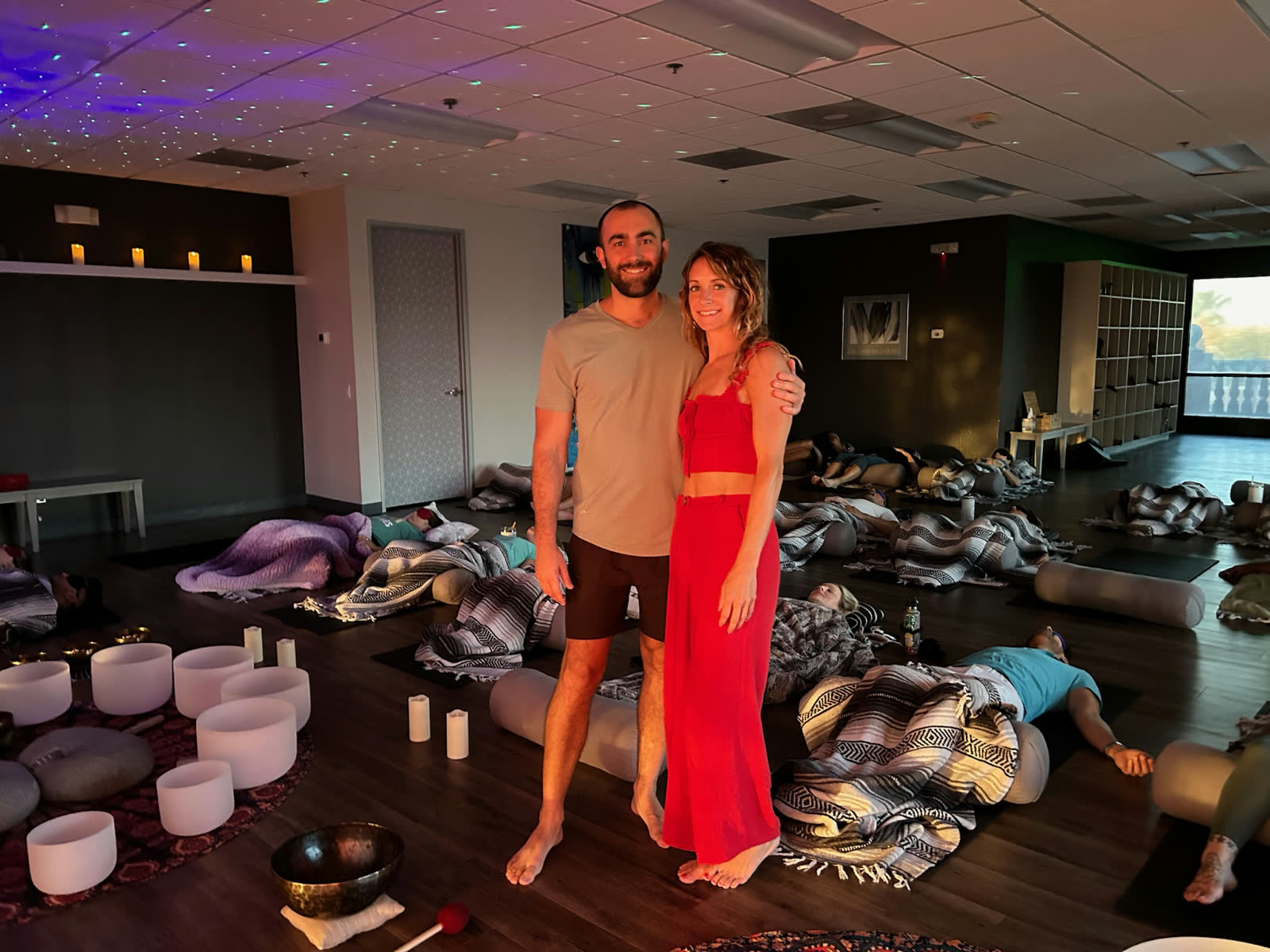
Quick Summary
A Breathwork course teaches breathing techniques, nervous system awareness, facilitation skills, safety, ethics, and integration support. The right training depends on your goal: personal practice, adding Breathwork to an existing wellness business, or learning to guide groups professionally.
Liquid Breathwork offers a Breathwork training with 24 in-person hours plus an online curriculum, max 6 students per cohort, and $1,497 pricing. The training is led by Ryan McBurney and Shelby Von Oepen, RN, BSN. The method is surrender-based, not cathartic or screaming-based.
A Breathwork course can mean a lot of different things.
Some Breathwork courses are short online introductions. Some are personal development experiences. Some are professional trainings for yoga teachers, massage therapists, meditation guides, counselors, sound healing practitioners, wellness coaches, and future Breathwork facilitators.
That makes choosing one tricky.
The best Breathwork course for you depends on what you want to do with it. Are you learning Breathwork for yourself? Adding it to your current practice? Or training to hold space for other people in a real room with real nervous systems?
We built Liquid Breathwork around that last question.
Our Liquid Breathwork training is 24 hours of in-person training plus online modules. It is intentionally small, with a max of 6 students per cohort, because Breathwork is not something we think should be learned only through videos and quizzes.
Key Takeaways
- A Breathwork course should teach technique, safety, nervous system science, ethics, trauma awareness, and integration.
- Online Breathwork courses can be useful, but in-person practice matters if you want to facilitate groups.
- Breathwork facilitator training and Breathwork teacher training should include supervised practice, contraindications, and real feedback.
- Liquid Breathwork training is 24 hours of in-person training plus online modules, from $1,497.
- Our method is surrender-based, not cathartic, screaming-based, or performance-driven.
What Is a Breathwork Course?
A Breathwork course is a structured training that teaches breathing techniques, body awareness, nervous system regulation, safety, and integration practices.
At the basic level, a Breathwork course may teach simple breathing exercises like box breathing, 4-7-8 breathing, diaphragmatic breathing, coherent breathing, and extended exhales. These are useful tools for stress, sleep, anxiety, focus, and emotional regulation.
At the deeper level, a Breathwork course may teach conscious connected breathing, circular breathing, somatic Breathwork, trauma-informed facilitation, group facilitation, music sequencing, consent, touch ethics, contraindications, and integration support.
That deeper level is where the quality gap gets big.
A real Breathwork training is not just "breathe like this." It teaches what can happen when someone's nervous system opens up, how to support them safely, and when Breathwork is not appropriate.
Breathwork Course vs Breathwork Training
People often use "Breathwork course" and "Breathwork training" like they mean the same thing.
Sometimes they do. Sometimes they do not.
A Breathwork course is often shorter and more educational. A Breathwork training usually implies a more complete path that includes personal practice, facilitation skills, live practice, ethics, and support.
Here is the clean way to think about it:
| Path | Best For | What It Should Include |
|---|---|---|
| Intro Breathwork course | Personal practice | Basic techniques, safety, simple routines |
| Online Breathwork course | Flexible learning | Technique, nervous system basics, practice prompts |
| Breathwork facilitator training | Guiding individuals or groups | Facilitation, contraindications, ethics, integration |
| Breathwork teacher training | Teaching in wellness spaces | Sequencing, group leadership, safety, teaching skills |
| Somatic Breathwork training | Body-based emotional work | Nervous system awareness, trauma-informed support |
| Liquid Breathwork training | Deep practice + professional facilitation | 24 in-person hours, online curriculum, clinical science, mentorship |
If your goal is personal growth, a simple Breathwork course may be enough.
If your goal is to guide others, look for a full Breathwork facilitator training with real practice, real feedback, and live support.
What Should a Good Breathwork Course Include?
A good Breathwork course should go way beyond breathing patterns.
Breathing techniques matter, but they are only one piece. The bigger skill is knowing when to use them, how to adapt them, and how to support what comes up.
Here is what to look for.
1. Technique Variety
A strong Breathwork course should teach multiple styles, not one pattern presented as the answer to everything.
Useful techniques include diaphragmatic breathing, box breathing, 4-7-8 breathing, coherent breathing, extended exhale breathing, breath holds and retentions, conscious connected breathing, circular breathing, somatic Breathwork, pranayama-inspired breathing, and down-regulating recovery breath.
Different techniques create different effects. A slow nasal breathing practice can calm the nervous system. Conscious connected breathing can bring up emotion, sensation, memory, or altered states. Breath holds can shift carbon dioxide tolerance and stress response. A good Breathwork training teaches the difference.
2. Nervous System Science
Breathwork works through the body, not just the mind.
A Breathwork course should explain the autonomic nervous system, sympathetic activation, parasympathetic recovery, vagal tone, carbon dioxide tolerance, respiratory alkalosis, and the stress response.
That sounds clinical, but it matters. If someone feels tingling, tightness, trembling, emotional release, temperature changes, or altered awareness, the facilitator needs to understand what may be happening. Not to diagnose. To hold space calmly and safely.
This is one reason Shelby Von Oepen, RN, BSN teaches clinical science inside Liquid Breathwork training. She brings 14 years of nursing experience, which helps students understand the body with more precision.
3. Safety and Contraindications
Any Breathwork course that skips contraindications is a red flag.
Breathwork can be powerful. Some styles may not be appropriate for people with certain medical or psychological conditions. A strong training should discuss extra caution around pregnancy, cardiovascular conditions, uncontrolled high blood pressure, history of seizures, recent surgery, severe asthma or respiratory conditions, glaucoma or retinal issues, acute psychiatric instability, recent trauma without proper support, and substance use or altered-state vulnerability.
This does not mean Breathwork is unsafe for everyone in these categories. It means a trained facilitator needs to screen, modify, refer out when needed, and stay inside scope of practice.
4. Trauma-Informed Facilitation
Breathwork can bring people into deep emotional territory.
A trauma-informed Breathwork course should teach consent, pacing, nervous system tracking, grounding, choice, and integration. It should not pressure people to push harder, breathe bigger, scream louder, or perform emotional release.
Liquid Breathwork is surrender-based. We are not chasing catharsis. The work is creating a safe enough container for the body to soften, release, feel, and reorganize at its own pace.
5. Live Practice and Feedback
You cannot learn facilitation only by watching videos.
Online Breathwork courses can teach concepts. They can give you language, frameworks, and technique breakdowns. But holding space for another person is a body-based skill. You need to feel the room. You need to notice when someone is dissociating, bracing, over-efforting, or dropping into surrender. You need feedback from instructors who can see what you are doing.
That is why our Liquid Breathwork training includes 24 in-person hours and keeps cohorts to a max of 6 students. Small groups create better feedback. Better feedback creates safer facilitators.
Online Breathwork Course: Is It Enough?
An online Breathwork course can be enough if your goal is personal practice or basic education.
It may not be enough if your goal is to facilitate deep sessions for other people.
Online learning is useful for studying anatomy and physiology, learning contraindications, watching demonstrations, building personal practice, understanding sequencing, reviewing ethics and scope of practice, and completing homework and reflection.
But Breathwork facilitation is relational. You are not just teaching a breathing pattern. You are tracking breath, body, emotion, sound, silence, resistance, surrender, and integration. That takes live practice.
The best Breathwork training online is usually hybrid. You get the flexibility of online education, plus the real-world learning of in-person practice. Liquid Breathwork uses that hybrid model because it respects both sides.
Breathwork Facilitator Training vs Breathwork Teacher Training
Breathwork facilitator training and Breathwork teacher training overlap, but they are not always identical.
A Breathwork teacher may focus on explaining techniques, leading classes, and teaching breathing exercises in yoga studios, wellness centers, retreats, or corporate wellness settings.
A Breathwork facilitator often goes deeper into holding space for emotional release, altered states, somatic processing, and integration. Both roles need safety training, communication skills, and clarity about where Breathwork ends and therapy, medicine, or clinical care begins.
This matters for yoga teachers, massage therapists, meditation teachers, counselors, sound healing practitioners, and wellness coaches who want to add Breathwork to existing work. A good Breathwork course should help you integrate it into your current scope, not pretend one training turns everyone into everything.
Who Is a Breathwork Course Best For?
A Breathwork course can be useful for a wide range of people.
A basic Breathwork course may be best for:
- People who want tools for stress relief
- Beginners who want a daily breathing practice
- People exploring meditation alternatives
- Athletes working on recovery and focus
- Anyone curious about nervous system regulation
- People who want better sleep or emotional grounding
A full Breathwork training may be best for:
- Yoga teachers
- Massage therapists
- Sound healing practitioners
- Meditation teachers
- Counselors and therapists
- Wellness coaches
- Retreat leaders
- Nurses and healthcare-adjacent professionals
- Somatic practitioners
- People who want to facilitate Breathwork groups
- Career changers entering the wellness space
What Makes Liquid Breathwork Training Different?
Liquid Breathwork training is built for people who want depth without theatrics.
Ryan McBurney is the founder and lead facilitator. Shelby Von Oepen, RN, BSN brings 14 years of nursing experience and teaches clinical science. Together, we teach Breathwork as a grounded, body-based practice that blends nervous system education, facilitation skill, personal practice, and integration.
The training includes:
- 24 in-person hours
- Max 6 students per cohort
- $1,497 pricing
- Online education plus live practice
- Clinical science with Shelby Von Oepen, RN, BSN
- Facilitation training with Ryan McBurney
- Surrender-based methodology
- Trauma-informed principles
- Integration and mentorship
Ryan has 8 years of experience in this work, and Liquid Breathwork has 54 students enrolled. We keep the training small on purpose. A lot of Breathwork courses scale fast. We care more about building facilitators who can hold a steady room.
Surrender-Based Breathwork vs Cathartic Breathwork
Not every Breathwork course teaches the same philosophy.
Some Breathwork trainings lean into intensity. Big music, big breathing, big emotional release. Sometimes that includes screaming, shaking, pushing, or trying to "break through."
Liquid Breathwork is different. Our method is surrender-based. That means we are not trying to overpower the body. We are not trying to make emotion happen. We create conditions for the nervous system to open safely.
That may include emotion. It may include tears. It may include stillness. It may include insight, body sensation, memory, peace, resistance, or nothing dramatic at all. The goal is not a show. The goal is honest contact with the body.
How Much Does a Breathwork Course Cost?
Breathwork course pricing varies widely.
Short online Breathwork courses may cost under $100. Deeper online Breathwork courses may cost a few hundred dollars. Professional Breathwork facilitator training can range from $1,000 to $10,000 or more depending on hours, live instruction, mentoring, in-person training, and included credentials.
Liquid Breathwork training is $1,497. That includes 24 hours of in-person training plus online modules, and small cohort support.
Price matters, but it should not be the only factor. The better question is: will this Breathwork course prepare me for the way I actually want to use Breathwork?
Questions to Ask Before Choosing a Breathwork Course
Before you choose a Breathwork course, ask better questions than "How fast can I finish?"
- How many total hours are included?
- Is there live practice or only prerecorded content?
- Does the training include contraindications and safety?
- Who teaches the clinical science?
- Is there trauma-informed facilitation training?
- Are cohorts small enough for real feedback?
- Does the course teach integration, not just technique?
- Is the method cathartic, surrender-based, therapeutic, or performance-based?
- Does it fit my current scope of practice?
- Will I feel confident holding space after this, or just informed?
If the course cannot answer those clearly, keep looking. Breathwork is too powerful for vague training.
Frequently Asked Questions
What is the best Breathwork course?
The best Breathwork course depends on your goal. For personal practice, a short online course may be enough. For professional facilitation, look for Breathwork training with live practice, safety, contraindications, trauma-informed principles, and instructor feedback.
Can I take a Breathwork course online?
Yes, you can take a Breathwork course online. Online Breathwork courses are useful for learning technique, anatomy, nervous system science, and personal practice. If you want to facilitate others, a hybrid format with in-person practice is usually stronger.
How long does Breathwork training take?
Breathwork training can range from a few hours to several hundred hours. Liquid Breathwork training is 24 hours of in-person training plus online modules. The right length depends on whether you want personal tools or professional facilitation skills.
What should I look for in Breathwork facilitator training?
Look for Breathwork facilitator training that includes safety, contraindications, trauma-informed facilitation, nervous system science, ethics, integration, live practice, and feedback. Small cohorts are helpful because facilitation is learned through direct experience, not just content.
Is Breathwork training good for yoga teachers and massage therapists?
Yes, Breathwork training can be a strong fit for yoga teachers and massage therapists. It also pairs well with meditation, sound healing, counseling, somatic work, and wellness coaching. The key is choosing training that respects scope of practice and teaches safe facilitation.
How much does Liquid Breathwork training cost?
Liquid Breathwork training costs $1,497. It includes 24 hours of in-person training plus online modules, and a max of 6 students per cohort. The training is led by Ryan McBurney and Shelby Von Oepen, RN, BSN.
Ready to Start Your Breathwork Training?
Our Facilitator Training gives you 24 hours of in-person training plus online modules, clinical science from a registered nurse, and mentorship in cohorts capped at 6 students. Surrender-based. Starting at $1,497.
Experience Breathwork First
Join our community and start your 7-day free trial today.