Quick Summary
Breathwork training teaches you how to safely guide others through intentional breathing practices for nervous system regulation, emotional processing, meditation, relaxation, and personal growth.
The right training should include live practice, trauma-informed facilitation skills, anatomy and physiology, ethics, contraindications, supervised teaching, business basics, and clear support after graduation. Liquid Breathwork training is a pathway with 24 in-person hours plus an online curriculum, max 6 students per cohort, and direct instruction from Ryan McBurney and Shelby Von Oepen, RN, BSN. The method is surrender-based, not cathartic or screaming-based.
Breathwork training is for people who want more than a personal practice.
Maybe you already love Breathwork. Maybe you are a yoga teacher, massage therapist, counselor, nurse, meditation guide, sound healer, wellness coach, or just the person everyone comes to when life gets heavy.
At some point, the question gets real: How do we learn to hold this safely for other people?
That is what Breathwork training should answer. Not just how to breathe. Not just how to build a playlist. Not just how to say calming things while people lie on mats.
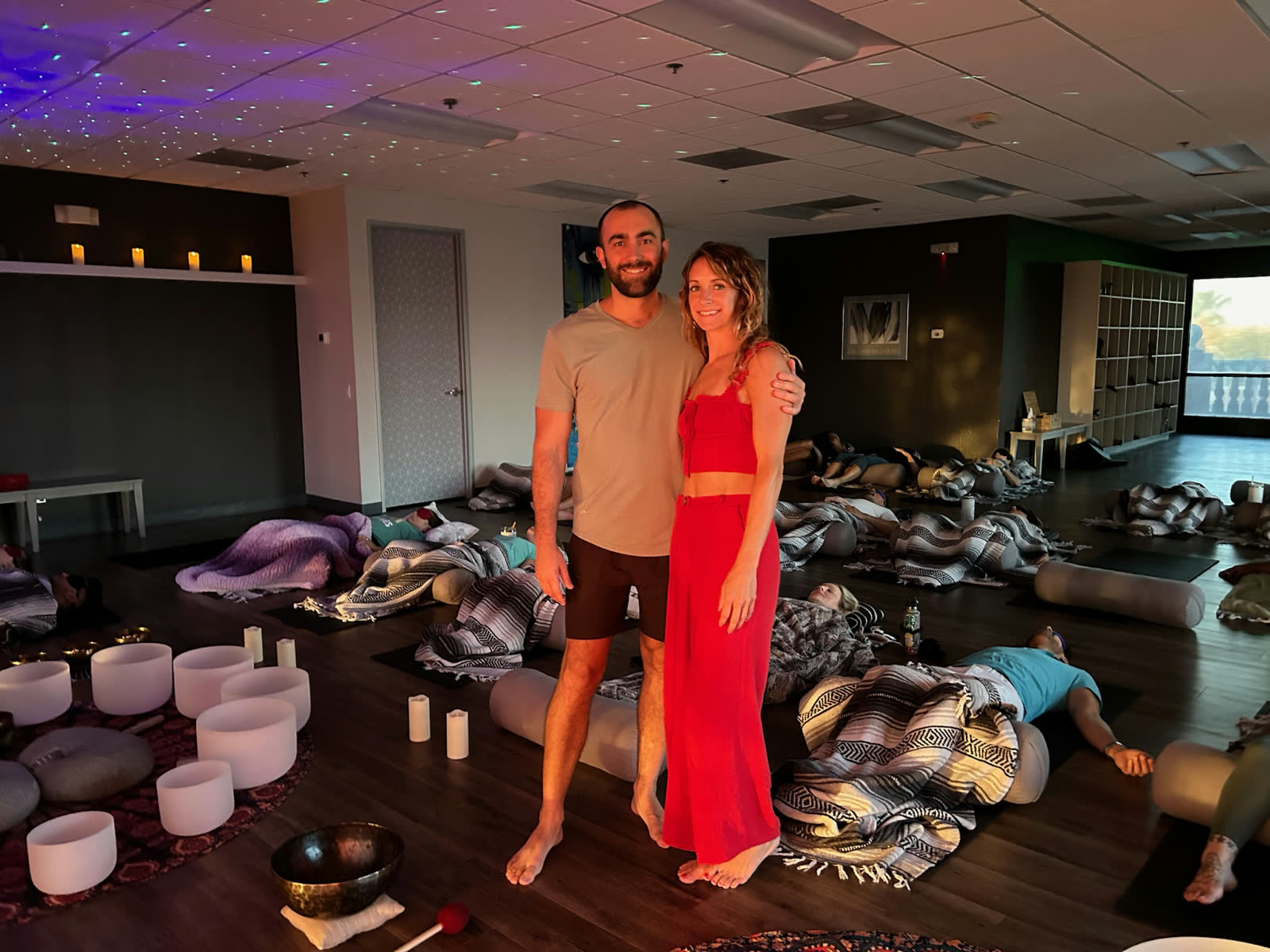
A good training teaches the full container: body, nervous system, emotional safety, facilitation, ethics, scope of practice, sequencing, integration, and what to do when someone has a strong experience.
The Breathwork space is growing fast. That is good, but it also means there are a lot of programs that look similar on the outside. Here is how to choose the right one without getting lost in the noise.
What Is Breathwork Training?
Breathwork training is a structured program that teaches you how to guide intentional breathing practices for individuals or groups.
That can include:
- Conscious connected breathing
- Somatic Breathwork
- Diaphragmatic breathing
- Box breathing
- 4-7-8 breathing
- Coherent breathing
- Breath retention practices
- Down-regulation techniques
- Nervous system education
- Integration and reflection
- Group facilitation skills
A strong training should help you understand when each technique is useful. For example, box breathing works well for focus and steadiness. Coherent breathing supports heart rate variability and nervous system regulation. Conscious connected breathing can create deeper emotional release and altered-state experiences. Those are not the same thing.
A two-minute breathing tool before a meeting is different from guiding a 75-minute group Breathwork journey where someone may cry, shake, feel old grief, experience tingling, or enter a deeply meditative state. Training should teach that difference clearly.
Breathwork Facilitator Training vs Breathwork Teacher Training
People use "facilitator," "teacher," "coach," "guide," and "instructor" in slightly different ways. The words overlap, but there are useful distinctions.
A Breathwork teacher usually focuses on education and technique. They may teach breathing patterns, explain benefits, and guide simple practices. A Breathwork facilitator holds a deeper experience. They are responsible for the container, music, pacing, safety, emotional support, group energy, and integration. A Breathwork coach may use breathing tools inside a broader coaching relationship.
The title matters less than the actual training. Better questions:
- Did you practice guiding real people?
- Did you get feedback?
- Did you learn contraindications?
- Did you learn trauma-informed facilitation?
- Did you study the nervous system?
- Did you learn what is inside and outside your scope?
- Did you leave with a clear method?
If the answer is no, the title will not save you.
Online Breathwork Training vs In-Person Breathwork Training
Online training can be useful. It gives flexibility, access, and lower travel costs. But Breathwork is a body-based practice. At some point, you need real-time human practice.
You need to feel what happens in a room. You need to see breathing patterns change. You need to notice when someone is forcing, bracing, dissociating, over-breathing, or needing support. That is hard to learn from videos alone.
The best setup is usually a hybrid model:
- Online education for theory and preparation
- Live group calls for discussion and mentorship
- In-person training for facilitation practice
- Supervised sessions for feedback
- Ongoing support after the training
That is how Liquid Breathwork training is built. Our training includes 24 in-person hours plus an online curriculum, with a and a max of 6 students per cohort. That small group size matters because students get watched, corrected, supported, and coached in real time. You are not hiding in the back of a room with 40 people. You are learning how to actually facilitate.
Explore the full training here: Liquid Breathwork training. For a broader overview of what breathwork teacher training involves, visit our breathwork teacher training hub.
If the facilitation side is what you are after, read our Breathwork facilitator training page.
What Should a Breathwork Course Include?
A Breathwork course should include more than breath patterns. Breathing is the tool. Facilitation is the skill.
1. Anatomy and Physiology
You should understand what happens in the body during Breathwork. That includes the respiratory system, nervous system, carbon dioxide tolerance, oxygen saturation, pH shifts, heart rate, muscular tension, and common physical sensations like tingling or temperature changes. You do not need to become a doctor. But you should not be guessing.
This is one reason Shelby Von Oepen, RN, BSN teaches clinical science inside Liquid Breathwork training. Shelby brings 14 years of nursing experience, which helps students understand the body in a grounded way.
2. Nervous System Regulation
Breathwork can activate. It can also down-regulate. Training should teach both. Some people need energy, movement, and emotional release. Others need safety, slowness, and grounding. A good facilitator can read the difference. You should understand sympathetic activation, parasympathetic recovery, fight/flight/freeze/fawn, and how to support integration after a session.
3. Trauma-Informed Facilitation
Trauma-informed does not mean you become a therapist. It means you learn how to create choice, consent, pacing, safety, and agency. That includes offering options instead of commands, avoiding pressure to perform, letting people stop anytime, avoiding forced catharsis, knowing when to refer out, respecting personal boundaries, and supporting grounding after intensity.
Liquid Breathwork is surrender-based. The goal is not to force a dramatic release. The goal is to create enough safety for the body to let go in its own timing.
4. Contraindications and Safety
Not everyone should do every Breathwork practice. Training should cover contraindications, modifications, and intake processes. This can include considerations around pregnancy, cardiovascular conditions, seizure history, certain psychiatric conditions, recent surgery, glaucoma, blood pressure, and medications. Safety is not optional.
5. Practice Teaching
You cannot learn facilitation by only watching someone else facilitate. You have to guide real sessions. You need to practice your voice, pacing, cueing, timing, music, room setup, opening talk, closing integration, and how to respond when things do not go as planned. Good training includes feedback. Not vague encouragement. Real feedback.
6. Ethics and Scope of Practice
Breathwork can be powerful, which means ethics matter. Training should cover consent, confidentiality, referrals, marketing claims, client boundaries, and how to avoid acting outside your lane. Good facilitators do not pretend to be everything.
7. Business and Integration
If you want to offer Breathwork professionally, you need to know how to start. That can include pricing sessions, running groups, partnering with studios, creating intake forms, building referral relationships, and combining Breathwork with sound healing, meditation, yoga, massage therapy, counseling, or wellness coaching.
How Long Does Breathwork Training Take?
Breathwork training can range from a weekend to several hundred hours. A short weekend can be useful if you want an introduction. It is usually not enough if you want to guide deeper sessions with confidence.
Liquid Breathwork training is 24 hours of in-person training plus online modules. That covers online study, live training, practice, and integration. The in-person portion is important because Breathwork is relational. You are learning how to read a room, hold space, support people safely, and stay regulated while other people move through real experiences.
Ryan McBurney leads the method and facilitation training. He is the founder of Liquid Breathwork with 8 years of experience in Breathwork and facilitation. Shelby Von Oepen, RN, BSN teaches the clinical science side. Her 14 years in nursing help students connect the practice to real physiology, safety, and nervous system education.
How Much Does Breathwork Training Cost?
Breathwork training pricing varies a lot. Some online programs cost a few hundred dollars. Larger professional trainings can cost several thousand.
Liquid Breathwork training starts at $1,497 for the online cohort. In-person intensive options start at $1,997 early bird, with upcoming Phoenix cohorts on September 25-27, October 23-25, and November 6-8, 2026. All paths include 24 hours of in-person training plus online modules, small cohort support, and direct instruction from Ryan and Shelby. We keep cohorts at a max of 6 students because the goal is not to pack a room. The goal is to train people well.
You can see the full breakdown here: Liquid Breathwork training details.
What Makes Liquid Breathwork Training Different?
Liquid Breathwork is not built around forcing catharsis. The method is surrender-based. That means the facilitator creates a safe container, guides the breathing pattern, supports the nervous system, and lets the body lead. Sometimes that looks emotional. Sometimes it looks quiet. Sometimes it looks like someone finally stopped gripping for the first time in years.
All of that counts.
The training also focuses on practical facilitation. You learn how to run a room. You learn how to talk before and after a session. You learn how to use music without hiding behind it. You learn how to support different bodies, different nervous systems, and different levels of experience.
The training includes clinical science that is relevant to bodyworkers. That makes it a strong fit for:
- Yoga teachers who want to add Breathwork classes
- Massage therapists who want nervous system tools
- Meditation teachers who want a more somatic practice
- Sound healers who want to deepen their events
- Counselors and therapists who want to understand Breathwork referrals and integration
- Wellness coaches who want practical breathing tools
- Retreat leaders who want to hold stronger containers
Is Breathwork Training Worth It?
Breathwork training is worth it if you want to guide people safely and you are willing to practice. It is probably not worth it if you only want a title, a quick badge, or a new thing to sell next week.
The real value is not the piece of paper. It is the skill. Can you guide a nervous group into trust? Can you explain contraindications clearly? Can you support someone who gets emotional without making it about you? Can you hold silence? Can you stop over-cueing? Can you help someone integrate instead of chasing another peak experience?
Breathwork training can also be a smart professional add-on. If you already work in yoga, massage therapy, meditation, counseling, sound healing, health coaching, fitness, or retreats, Breathwork gives you another way to support the body and nervous system. It can become a standalone class, a private session, a workshop, a retreat element, or a tool you weave into your existing work.
How to Choose the Best Breathwork Training for You
Use this checklist before choosing a program.
Look at the Method
Does the training teach a clear method, or is it just a collection of techniques? If you want to facilitate deeper somatic Breathwork, make sure the program goes beyond basic breathing exercises.
Check the Safety Training
Ask what the program teaches around contraindications, trauma-informed practice, consent, and scope. If safety is treated like a footnote, that is a red flag.
Ask How Much Live Practice You Get
You need to facilitate. Not just watch. Not just read. Not just complete quizzes. Ask how many times you will practice guiding, whether you will receive feedback, and whether the instructors actually see you work.
Look at Cohort Size
Large groups can be powerful, but they are not always ideal for learning. A smaller cohort usually means more feedback, more practice, and more direct access to instructors. Liquid Breathwork caps cohorts at 6 students for this reason.
Know Your Goals
A yoga teacher may need something different than a counselor. A massage therapist may care about continuing education. A sound healer may want to build better event flow. A wellness coach may want practical tools for clients. Choose training that fits the work you actually want to do.
Who Breathwork Training Is Best For
Breathwork training is a good fit if you are already drawn to nervous system work, body-based healing, emotional regulation, or group facilitation. It is especially useful for:
- Yoga teachers
- Massage therapists
- Nurses and healthcare-adjacent professionals
- Counselors and therapists
- Meditation teachers
- Sound healing practitioners
- Wellness coaches
- Retreat facilitators
- Fitness and performance coaches
- People who want to lead Breathwork circles or classes
You do not need to have everything figured out before you start. But you should have respect for the work. Breathwork can be simple, but simple does not mean shallow. The breath touches physiology, emotion, memory, stress, identity, and the nervous system. That deserves good training.
Frequently Asked Questions
What is the best Breathwork training?
The best Breathwork training depends on your goals, but it should include live practice, anatomy, nervous system education, trauma-informed facilitation, contraindications, ethics, supervised teaching, and integration. If you want to guide groups or private clients, choose a program with real feedback and in-person practice.
How long does Breathwork training take?
Breathwork training can range from a weekend to several hundred hours. Liquid Breathwork training is 24 hours of in-person training plus online modules covering online study, live instruction, practice, and integration.
Can I do Breathwork training online?
Yes, online Breathwork training can be useful for theory, technique, and discussion. But if you want to facilitate deeper Breathwork sessions, we recommend training that includes live or in-person practice so you can learn how to read bodies, pace a room, and support people safely.
What is the difference between a Breathwork facilitator and a Breathwork coach?
A Breathwork facilitator usually guides full Breathwork experiences or group sessions. A Breathwork coach may use breathing tools inside a broader coaching relationship. The roles overlap, but the quality of training matters more than the title.
Is Breathwork training good for yoga teachers and massage therapists?
Yes. Breathwork pairs naturally with yoga, massage therapy, meditation, sound healing, counseling, and wellness coaching.
How much does Liquid Breathwork training cost?
Liquid Breathwork training starts at $1,497 for the online cohort. In-person intensive options start at $1,997 early bird. All paths include 24 hours of in-person training plus online modules, small cohort training, and direct instruction from Ryan McBurney and Shelby Von Oepen, RN, BSN.
Ready to Start Your Breathwork Training?
Our Facilitator Training gives you 24 hours of in-person training plus online modules, clinical science from a registered nurse, and mentorship in cohorts capped at 6 students. Surrender-based. Starting at $1,497.
Experience Breathwork First
Join our community and start your 7-day free trial today.