Quick Summary
Breathwork practitioner training teaches you how to guide clients through conscious breathing practices in a safe, grounded, trauma-aware way. A strong program should include technique, facilitation skills, nervous system education, ethics, practice teaching, integration, and supervised feedback.
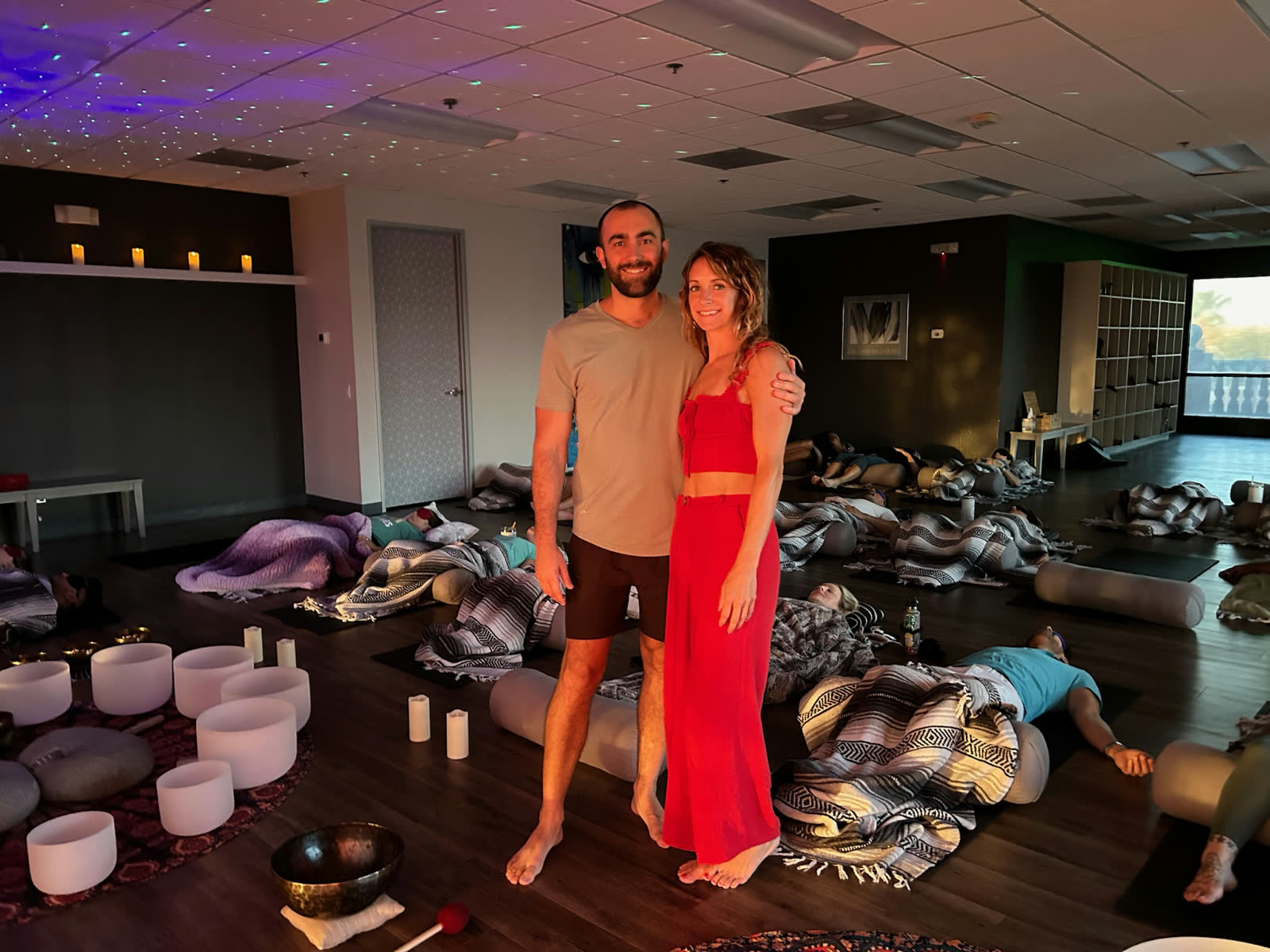
Liquid Breathwork offers a training pathway with 24 in-person hours plus an online curriculum, max 6 students per cohort, 54 students enrolled, and instruction from Ryan McBurney and Shelby Von Oepen, RN, BSN. The method is surrender-based, not cathartic or screaming-based.
Ready to train? Our live Breathwork practitioner certification runs online or in person, with payment plans on every format.
Breathwork practitioner training is for people who want to guide others through intentional breathing practices, not just use Breathwork for themselves.
That might mean private sessions, small groups, retreats, wellness events, corporate workshops, yoga studio classes, massage therapy add-ons, counseling support, sound healing sessions, or coaching containers.
The main thing is this: guiding Breathwork is different from doing Breathwork.
When you are leading someone else, you are responsible for the space, pacing, safety, nervous system cues, emotional release, integration, and the overall arc of the session. Good training helps you build those skills before you put people on the mat.
If you are comparing options, here is what to look for, what to avoid, and how Liquid Breathwork approaches practitioner training.
What Is Breathwork Practitioner Training?
Breathwork practitioner training is a structured program that teaches you how to facilitate Breathwork sessions for other people.
A complete program usually includes:
- Breathwork technique and session structure
- Nervous system education
- Trauma-aware facilitation
- Contraindications and safety screening
- Music and session design
- Client intake and integration
- Ethics and scope of practice
- Practice teaching
- Feedback from instructors
- Business basics for offering sessions
Some programs focus heavily on performance, intensity, or emotional catharsis.
Others focus more on regulation, presence, surrender, and integration.
At Liquid Breathwork, we teach a surrender-based approach. That means we are not trying to force a breakthrough, push people into catharsis, or create a room full of screaming.
The work can still be deep. People may cry, shake, laugh, feel emotional waves, or experience big body sensations.
But the goal is not intensity for intensity's sake. The goal is to create a safe enough space for the body to release what it is ready to release.
That difference matters.
Breathwork Practitioner Training vs Breathwork Facilitator Training
People use these phrases in slightly different ways, but they usually point to the same core path.
Breathwork practitioner training often sounds more client-facing. It usually means you want to use Breathwork as part of a wellness practice, coaching practice, bodywork practice, therapy-adjacent practice, or healing arts practice.
Breathwork facilitator training usually emphasizes leading sessions, groups, circles, and events.
Our Breathwork facilitator training page lays out what leading full sessions actually asks of you.
Breathwork teacher training may be used by yoga studios, online programs, or schools that frame the work like a teaching pathway.
Breathwork coach training usually attracts people who want to support transformation, behavior change, nervous system regulation, or personal growth.
In real life, the skill set overlaps.
You need to know how to hold space, read the room, cue breathing patterns, explain safety guidelines, guide integration, and stay grounded when someone has a strong experience.
The title matters less than the training quality.
Who Breathwork Practitioner Training Is For
Breathwork training can be a strong fit if you already work with people in a healing, wellness, or personal development setting.
Common students include:
- Yoga teachers
- Massage therapists
- Meditation teachers
- Sound healing practitioners
- Counselors
- Therapists
- Wellness coaches
- Fitness coaches
- Retreat leaders
- Nurses and health professionals
- Bodyworkers
- Energy workers
- People hosting circles or community events
You do not need to already be a full-time wellness professional.
But you do need emotional maturity, humility, and a real respect for the nervous system.
Breathwork can open a lot quickly. That is why the training should be deeper than "learn a breathing pattern and make a playlist."
If you want to guide people through altered states, emotional release, or deep somatic experiences, you need a real foundation.
What Should a Breathwork Practitioner Training Include?
A strong Breathwork practitioner training should give you more than a script.
You want a complete framework that helps you understand what is happening before, during, and after a session.
Here are the major pieces to look for.
1. Breathwork Techniques and Variations
There are many Breathwork styles.
Some are gentle and regulation-focused. Others are activating, circular, rhythmic, or transformational.
A good program should help you understand the difference between techniques like:
- Conscious connected breathing
- Circular breathing
- Diaphragmatic breathing
- Box breathing
- 4-7-8 breathing
- Coherent breathing
- Somatic Breathwork
- Holotropic-style Breathwork
- Wim Hof-style breathing
- Breath holds and retention practices
- Nasal breathing
- Extended exhales for downshifting
Not every practitioner needs to teach every technique.
But you should understand the landscape, especially if clients ask about different styles.
You should also know when not to use certain techniques.
Fast, activating Breathwork is not the right fit for every person or every nervous system state. Breath holds, intense hyperventilation-style practices, and long sessions can carry more risk for certain students.
That is why safety screening matters.
2. Nervous System Education
Breathwork is not just "take deeper breaths."
It affects the autonomic nervous system, carbon dioxide tolerance, oxygen balance, heart rate variability, muscular tension, emotional processing, and state shifts.
You do not need to become a neuroscientist.
But you should understand the basics of:
- Sympathetic activation
- Parasympathetic regulation
- Fight, flight, freeze, and fawn responses
- Window of tolerance
- Dissociation
- Grounding
- Integration
- Emotional release
- Somatic tracking
- Contraindications
This is one reason Liquid Breathwork includes Shelby Von Oepen, RN, BSN as an instructor.
Shelby brings 14 years of nursing experience as background to the science side of the training, which helps when students are learning to support and guide real people with real bodies.
3. Trauma-Aware Facilitation
Trauma-aware does not mean you become a therapist.
It means you understand that people may carry unresolved stress, grief, fear, shock, or protective patterns in the body.
It also means you do not force emotional release.
You learn how to offer choice, consent, pacing, and grounding. You learn how to avoid language that pressures someone to perform healing.
A trauma-aware Breathwork practitioner knows how to say:
- "You can slow down anytime."
- "You are in control of your breath."
- "You do not need to push."
- "Stay connected to the room."
- "Open your eyes if that feels better."
- "Let the body lead."
That tone is different from "break through your blocks" or "go harder."
At Liquid Breathwork, this is a core part of the method. We teach students to hold strong space without overpowering the person inside it.
Learn more about our approach: trauma-informed Breathwork.
4. Practice Teaching and Feedback
You cannot learn facilitation only by watching videos.
You need to practice.
You need to guide real breathing sessions, get feedback, notice your habits, and refine your presence.
This includes practical skills like:
- Opening a session
- Explaining the technique clearly
- Setting expectations
- Reading body language
- Cueing without over-talking
- Managing silence
- Supporting emotional release
- Closing the session
- Leading integration
- Handling questions afterward
Practice teaching is where the training becomes real.
You find out if your voice is rushed. You find out if you over-explain. You find out if you get nervous when someone cries.
That is normal.
Training gives you a container to learn before you are charging clients or leading groups on your own.
How Liquid Breathwork Practitioner Training Works
Liquid Breathwork offers a training pathway for students who want depth, structure, and real facilitation practice.
The training includes 24 in-person hours, max 6 students per cohort, and a $1,497 price point.
We keep cohorts small on purpose.
Breathwork is intimate work. A group of 30 can be powerful for an event, but it is not the best setting for learning the details of facilitation.
With a max of 6 students per cohort, you get more direct feedback, more practice time, and more access to the instructors.
The training is led by Ryan McBurney, founder and facilitator, and Shelby Von Oepen, RN, BSN.
Ryan brings 8 years of experience in Breathwork, facilitation, events, and building the Liquid Breathwork method. Shelby brings 14 years of nursing experience and teaches the clinical science, safety, and body-based education inside the program.
Liquid Breathwork has 54 students enrolled.
The pathway includes three professional training credentials, so students can build a more complete foundation across Breathwork facilitation, safety, and practice application.
You can learn more about the full program here: Liquid Breathwork Training.
Why We Teach a Surrender-Based Method
Some Breathwork spaces are built around catharsis.
They encourage loud release, big emotional expression, dramatic breakthroughs, and pushing past resistance.
That can work for some people. It can also be too much, too fast.
Our method is different.
Liquid Breathwork is surrender-based.
We are not trying to make someone scream, cry, shake, or have a spiritual experience. We are creating a space where the breath, body, music, and nervous system can guide the process.
Sometimes that process is emotional.
Sometimes it is quiet.
Sometimes the biggest release is a softening in the jaw, a deeper exhale, or the first moment of stillness someone has felt in months.
That is still real work.
As a practitioner, your job is not to perform intensity. Your job is to stay present, clear, ethical, and grounded while the client has their own experience.
That is what we train.
Breathwork Practitioner Training for Yoga Teachers
Yoga teachers often make strong Breathwork practitioners because they already understand breath, body awareness, group energy, and nervous system shifts.
But Breathwork facilitation is not the same as pranayama in a yoga class.
Many yoga breathing practices are shorter, more controlled, and woven into movement or meditation. Breathwork sessions can be longer, more immersive, and more emotionally active.
If you teach yoga, Breathwork training can help you add:
- Breath-focused workshops
- Nervous system classes
- Retreat sessions
- Private Breathwork add-ons
- Deeper savasana experiences
- Somatic integration practices
- Breath and sound healing events
The key is learning the difference between adding a few breathing exercises and guiding a full Breathwork journey.
That is where training matters.
Breathwork Practitioner Training for Massage Therapists and Bodyworkers
Massage therapists and bodyworkers already work with the body's holding patterns.
Breathwork can be a natural complement.
Clients often hold tension through the ribs, diaphragm, jaw, belly, shoulders, pelvic floor, and throat. Breathwork can help them become more aware of those patterns from the inside.
For massage therapists, Breathwork training can support:
- Pre-session grounding
- Post-session integration
- Standalone Breathwork sessions
- Somatic awareness practices
- Nervous system downshifting
- Client education around breath and tension
Liquid Breathwork is especially relevant for massage therapists who want breath and nervous system education that connects directly to their work.
Learn more about the training pathway here: Liquid Breathwork Training.
Breathwork Practitioner Training for Counselors and Wellness Coaches
Counselors, therapists, and wellness coaches are often drawn to Breathwork because talk alone does not always reach the body.
Breathwork can help clients access sensation, emotion, awareness, and regulation in a different way.
But scope of practice matters.
A Breathwork practitioner should not diagnose, treat trauma, replace therapy, or promise mental health outcomes.
If you are already a licensed counselor or therapist, Breathwork may become a somatic tool inside your existing professional scope. If you are a coach or wellness practitioner, it may support emotional awareness, stress relief, embodiment, and integration.
Either way, the training should be clear about ethics.
You need to know what Breathwork can support, what it cannot replace, and when to refer out.
That is part of responsible facilitation.
How to Choose a Breathwork Practitioner Training
If you are comparing programs, look beyond the sales page.
Ask these questions:
- How many total training hours are included?
- Is there live practice teaching?
- Are there in-person hours?
- Who are the instructors?
- What is their real facilitation experience?
- Is nervous system safety taught clearly?
- Does the program cover contraindications?
- Is the method cathartic, clinical, spiritual, somatic, or regulation-based?
- How many students are in each cohort?
- Will you receive feedback on your facilitation?
Also pay attention to the tone.
If the program promises instant mastery, guaranteed income, or dramatic transformation for every client, be careful.
Breathwork is powerful, but it is not magic.
A grounded training should respect the work enough to teach nuance.
For a broader view of available programs: online Breathwork courses.
How Long Does It Take to Become a Breathwork Practitioner?
It depends on the program and your goals.
Some weekend workshops give you a basic introduction. Longer programs may run for months and include practice sessions, mentorship, case studies, in-person training, and advanced modules.
Liquid Breathwork's pathway includes 24 hours of in-person training plus online modules.
That gives students time to learn the method, practice, receive feedback, study the body, understand safety, and build confidence before guiding others professionally.
You do not need to rush.
A slower path often creates a better practitioner.
For more on the broader path: how to become a Breathwork facilitator and the somatic Breathwork practitioner path.
Can You Offer Breathwork After Training?
Yes, if your training prepares you well and you stay inside your scope.
Many students go on to offer Breathwork through:
- Private sessions
- Group classes
- Retreats
- Yoga studios
- Wellness centers
- Massage therapy practices
- Sound healing events
- Coaching programs
- Corporate wellness workshops
- Community circles
Start simple.
Lead small sessions. Practice your intake process. Get feedback. Keep learning.
The best practitioners are not the ones who memorize the most scripts. They are the ones who stay present, keep refining, and know how to create safety without controlling the experience.
Is Breathwork Practitioner Training Worth It?
It is worth it if you want to guide Breathwork responsibly.
If you only want personal practice, you may not need a full practitioner training. Classes, workshops, and retreats may be enough.
But if you want to hold space for other people, training matters.
You are working with breath, emotion, the nervous system, memory, sensation, and altered states. That deserves more than a quick online course and a playlist.
A good training helps you become safer, clearer, more confident, and more ethical.
That is the real value.
FAQ: Breathwork Practitioner Training
What is Breathwork practitioner training?
Breathwork practitioner training teaches you how to guide individuals or groups through intentional breathing practices. It usually includes technique, safety, nervous system education, facilitation skills, practice teaching, ethics, and integration.
What is the difference between a Breathwork practitioner and a Breathwork facilitator?
The terms are often used interchangeably. A practitioner may use Breathwork inside a wellness, coaching, bodywork, or therapeutic-adjacent practice, while a facilitator often leads sessions, groups, or events. The core skills are very similar.
Do I need experience before joining Breathwork training?
You do not always need professional experience, but it helps to have a personal Breathwork practice and emotional maturity. Yoga teachers, massage therapists, meditation teachers, sound healers, counselors, nurses, and wellness coaches often bring useful experience into training.
Is Liquid Breathwork training online or in person?
Liquid Breathwork includes 24 in-person hours as part of its training pathway. The in-person component helps students practice facilitation, receive feedback, and build real confidence in a small cohort.
How much does Liquid Breathwork training cost?
Liquid Breathwork training is $1,497. Cohorts are capped at 6 students, which allows for more personal feedback, practice time, and instructor support.
Is Liquid Breathwork training a good fit for massage therapists?
Yes. Breathwork education is especially relevant for massage therapists and bodyworkers who want to bring breath and nervous system regulation into their hands-on work. Shelby Von Oepen, RN, BSN teaches the clinical science, so the training connects directly to bodywork.
Ready to Start Your Breathwork Training?
Our Facilitator Training gives you 24 hours of in-person training plus online modules, clinical science from a registered nurse, and mentorship in cohorts capped at 6 students. Surrender-based. $1,497.
Experience Breathwork First
Join our community and start your 7-day free trial today.