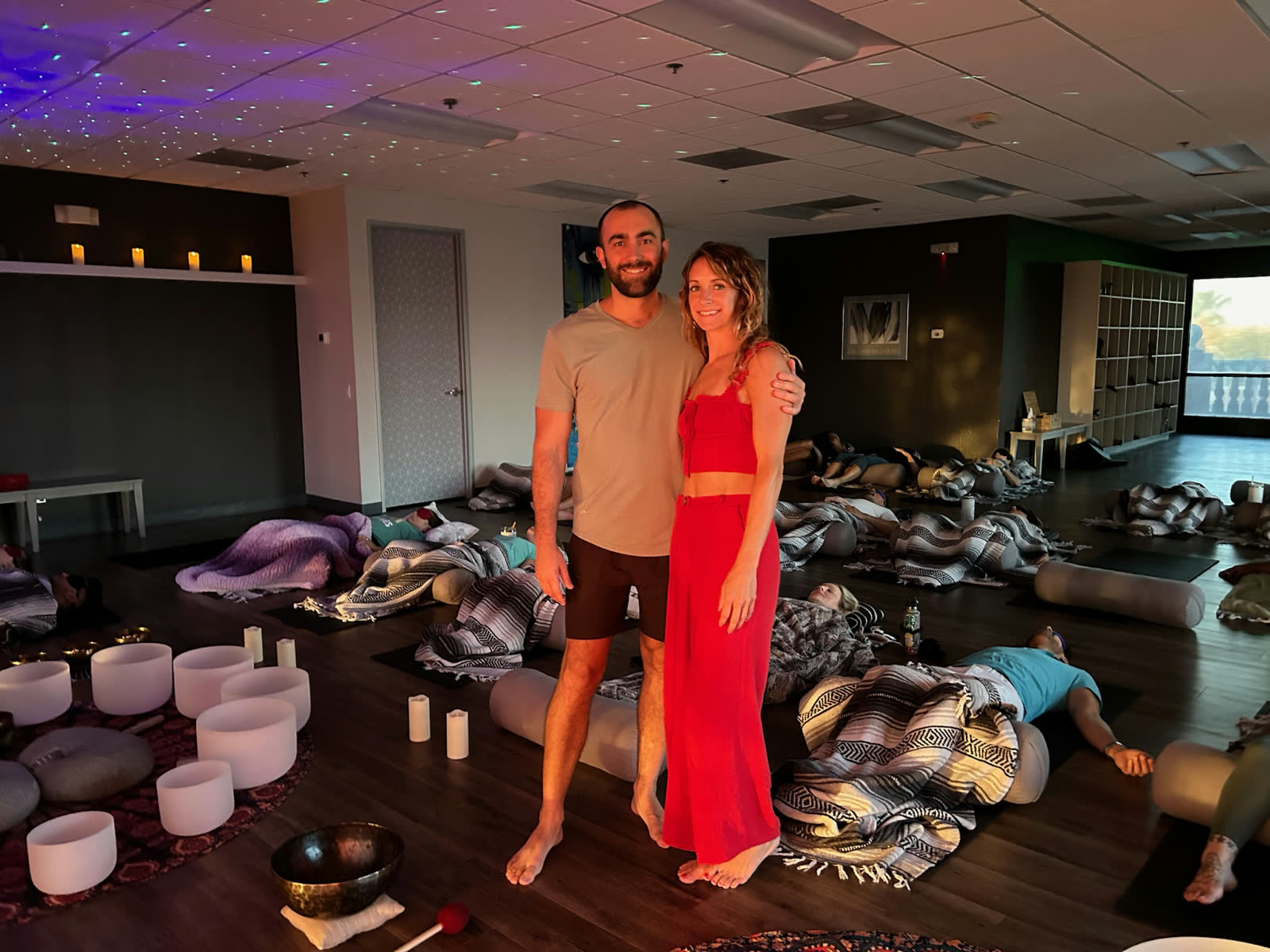
Quick Summary
A breathwork coach helps people use conscious breathing techniques for nervous system regulation, emotional processing, stress relief, and personal growth. The best Breathwork coach training includes deep personal practice, anatomy and physiology, contraindications, ethics, trauma-aware facilitation, supervised practice, integration support, and real mentorship.
Liquid Breathwork trains Breathwork coaches through a program with 24 in-person hours plus an online curriculum, a max of 6 students per cohort, and pricing starting at $1,497 for the online cohort. The method is surrender-based, not cathartic or screaming-based, and is taught by Ryan McBurney and Shelby Von Oepen, RN, BSN.
A breathwork coach is someone trained to guide people through intentional breathing practices for stress relief, emotional regulation, self-awareness, and deeper connection to the body.
That sounds simple, but good Breathwork coaching is not just "tell people to breathe harder."
A skilled breathwork coach knows how to read a room, support nervous system shifts, explain what is happening in the body, stay inside scope of practice, and help people integrate what comes up after a session.
At Liquid Breathwork, we train breathwork coaches through a training that includes 24 in-person hours plus an online curriculum, 8 years of experience behind the method, and 54 students enrolled so far. Our cohorts are capped at 6 students because this work needs real mentorship, not a giant webinar with a replay library.
If you are comparing Breathwork coach training options, start here: Liquid Breathwork training.
Key Takeaways
- A breathwork coach uses conscious breathing techniques to support stress relief, nervous system regulation, emotional release, and personal growth.
- Good Breathwork coach training should include anatomy, physiology, contraindications, ethics, facilitation practice, and integration coaching.
- Liquid Breathwork is surrender-based, not a cathartic, screaming, force-your-way-through-it style.
- Our training includes 24 hours of in-person training plus online modules, max 6 students per cohort, and starting at $1,497.
- Breathwork coaching fits naturally with yoga, massage therapy, meditation, sound healing, counseling, and wellness coaching.
What Does a Breathwork Coach Do?
A breathwork coach guides individuals or groups through structured breathing practices.
That can include slow nasal breathing, diaphragmatic breathing, conscious connected breathing, box breathing, 4-7-8 breathing, extended exhales, breath holds, or deeper somatic Breathwork sessions.
The goal depends on the session.
Some clients want stress relief. Some want help getting out of their head. Some want emotional processing. Some want a practice that supports therapy, meditation, yoga, massage therapy, or wellness coaching.
A breathwork coach does not diagnose, treat, or replace medical care. That line matters.
The work is about facilitation, not fixing people.
A strong coach creates a safe container, gives clear instructions, watches for signs of overwhelm, supports the person through the experience, and helps them land afterward.
That is the difference between "doing a breathing exercise" and being guided by someone trained to hold space.
Breathwork Coach vs Breathwork Facilitator vs Breathwork Teacher
The terms overlap, but they are not always the same.
A breathwork coach usually works with people around goals, habits, emotional patterns, or nervous system regulation.
A Breathwork facilitator usually guides deeper group or private sessions where the breath may bring up emotion, body sensations, memories, or altered states.
A Breathwork teacher may focus more on education, technique, and practice development.
In real life, many people use all three titles.
That is why Breathwork coach training, Breathwork facilitator training, Breathwork teacher training, and Breathwork practitioner training often describe the same general path with different language.
The better question is not "which title sounds best?" The better question is, "What am I actually trained to do safely?"
If a training gives you a script but no physiology, no supervised practice, no contraindication training, and no integration support, that is thin.
A real Breathwork coach needs more than confidence. They need discernment.
How to Become a Breathwork Coach
To become a breathwork coach, you need three things: personal practice, technical education, and supervised facilitation.
Personal practice comes first.
You cannot guide people into territory you have never entered yourself. Breathwork can bring up grief, shaking, tingling, fear, clarity, numbness, laughter, or deep calm. A coach needs to understand those states from the inside.
Technical education matters too.
That includes respiratory physiology, CO2 tolerance, nervous system states, trauma-aware language, contraindications, consent, scope of practice, and how to support someone who is activated or dissociated.
Then comes supervised practice.
This is where many online courses fall short. Watching videos is not the same as learning to facilitate a real person in real time.
At Liquid Breathwork, our Breathwork training includes 24 hours of in-person training plus online modules so students can practice facilitation, receive feedback, and learn how the work feels in the body.
We keep cohorts to a max of 6 students because smaller groups create better coaching. You get seen. You get corrected. You get to ask the awkward questions. That is where the real learning happens.
What Should Breathwork Coach Training Include?
A strong Breathwork coach training should cover the full arc of facilitation. Not just techniques. Not just marketing. Not just a weekend of peak experiences.
Here is what to look for:
| Training Element | Why It Matters | What to Watch For |
|---|---|---|
| Personal practice | You need lived experience with the breath | Training that is all theory |
| Anatomy and physiology | Breathwork changes CO2, oxygen, heart rate, and nervous system state | Programs that skip body science |
| Contraindications | Some practices are not appropriate for certain conditions | No safety screening |
| Trauma-aware facilitation | Breath can bring up stored emotion or protective responses | "Push through it" language |
| Scope of practice | Coaches need clear ethical boundaries | Claims that sound like therapy or medicine |
| Supervised practice | Real feedback builds real skill | No live practice requirement |
| Integration support | People need help making meaning after sessions | Sessions end abruptly with no landing |
| Business basics | Coaches need to communicate clearly and ethically | Hype-heavy sales scripts |
A good breathwork coach can explain the difference between down-regulating breath, activating breath, circular breath, breath retention, and slow coherent breathing. They also know when not to use a technique. That is just as important.
The Physiology a Breathwork Coach Needs to Understand
Breathwork is emotional, but it is also physical. A coach needs enough clinical science to understand what may happen during a session.
CO2 Tolerance
Carbon dioxide is not just waste gas. It plays a major role in breath drive, blood pH, oxygen delivery, and feelings of air hunger.
Fast breathing can lower CO2 levels, which may create tingling, lightheadedness, temperature changes, or shifts in perception.
Slow breathing and extended exhales can support parasympathetic activation and help the body settle.
A breathwork coach does not need to be a doctor. But they do need to understand what they are asking the body to do.
Nervous System Regulation
The breath gives direct access to the autonomic nervous system.
Short, sharp, intense breathing can increase activation. Slow nasal breathing can support regulation. Longer exhales can help some people feel safer.
But no technique works the same for every person.
Someone with anxiety may feel calm with box breathing, or they may feel trapped by it. Someone with trauma history may love deep connected breathing, or they may need more choice and grounding.
This is why coaching skill matters.
Emotional Release and Integration
Breathwork can bring emotion to the surface.
That does not mean the coach caused healing. It means the body had space to express something.
A good breathwork coach does not chase catharsis. They stay steady, offer simple support, and help the person integrate afterward.
At Liquid Breathwork, our method is surrender-based. We are not trying to force a breakthrough, make people scream, or push someone into a dramatic release. We create the conditions for the body to soften. That is different.
Our Surrender-Based Method at Liquid Breathwork
Liquid Breathwork is built around surrender, safety, and presence.
We are not interested in making Breathwork louder than it needs to be.
Some styles lean heavily into catharsis, screaming, intense emotional release, or "break through your limits" energy. We respect that some people connect with those spaces, but it is not how we teach.
Our approach is softer and still deep.
We use conscious connected breathing, somatic awareness, music, nervous system education, integration, and grounded facilitation. The work can still bring up emotion, but the point is not performance. The point is honesty.
Ryan McBurney, founder and facilitator, brings 8 years of experience in Breathwork, coaching, and group facilitation. Shelby Von Oepen, RN, BSN brings 14 years of nursing experience and teaches the clinical science inside the training.
That mix matters. Breathwork coach training needs both spiritual depth and physiological literacy. Too much "energy" without body science gets sloppy. Too much science without surrender gets dry. We teach the middle path.
Who Breathwork Coaching Is For
Breathwork coaching attracts people from a lot of backgrounds. Some are already in wellness work. Some are starting fresh. Some want to deepen their personal practice before ever charging for a session.
This path may fit you if you are:
- A yoga teacher who wants to add deeper nervous system work
- A massage therapist who wants to support emotional release safely
- A meditation teacher who wants a more body-based practice
- A sound healing practitioner who wants to guide deeper sessions
- A counselor or therapist who wants a complementary tool inside proper scope
- A wellness coach who wants more than mindset work
- A nurse, bodyworker, or holistic health practitioner who wants a grounded modality
- A career changer who feels called to facilitation
Breathwork coach training can also be useful if you do not want to coach professionally. Some people join because they want self-understanding, emotional regulation, and a stronger relationship with their own body. That is valid too.
Who Should Not Become a Breathwork Coach Yet
Breathwork coaching is not for everyone right away.
You may want to wait if you are trying to use coaching as a way to avoid your own work.
You may also want more support first if you are in an acute mental health crisis, recently destabilized, or looking for Breathwork to replace therapy, medication, or medical care.
This work asks for maturity.
You do not need to be perfectly healed. Nobody is. But you do need enough self-awareness to not make the session about you.
A breathwork coach holds space. They do not perform wisdom. They do not rescue. They do not push people where they are not ready to go. That takes practice.
Breathwork Coach Training Online vs In Person
Online Breathwork coach training can be useful for theory, anatomy, business basics, and community calls.
But Breathwork is body-based.
That means in-person practice still matters.
You learn things in the room that do not translate through a screen. You notice breathing patterns, facial tension, pacing, group energy, and subtle signs that someone needs grounding.
That is why Liquid Breathwork includes 24 in-person hours.
Our students also get structure outside the in-person training, but we do not pretend a video library can replace live mentorship.
A strong online breathwork course should still include live practice, feedback, office hours, and clear safety standards. If it is only pre-recorded content and a downloadable badge, keep looking.
How Much Does Breathwork Coach Training Cost?
Breathwork coach training pricing varies widely.
Some short online courses cost a few hundred dollars. Larger programs can cost several thousand dollars. Retreat-based trainings can cost even more once you add travel and lodging.
Liquid Breathwork training starts at $1,497 for the online cohort.
That includes 24 hours of in-person training plus online modules, direct mentorship, and a small cohort capped at 6 students.
We price it that way because we want serious students to have access without turning the training into a luxury retreat price.
If you are comparing options, do not only compare cost. Compare depth, safety, access to instructors, live practice, clinical education, group size, and whether the training actually prepares you to facilitate people.
Cheap training can become expensive if you leave unsure what to do with a real client.
Questions to Ask Before Choosing Breathwork Coach Training
Before joining any Breathwork coach training, ask direct questions. You are allowed to be picky.
Use this checklist:
- How many total training hours are included?
- Is there live facilitation practice?
- Are anatomy, physiology, and contraindications taught clearly?
- Who teaches the clinical science?
- How many students are in each cohort?
- Is the method cathartic, surrender-based, trauma-aware, or something else?
- What kind of mentorship is included?
- Does the training include business and ethics?
- Are students taught scope of practice?
- What support exists after the training ends?
If the answers are vague, that tells you something. Good Breathwork training should be easy to explain.
Breathwork Coaching and Scope of Practice
This part matters a lot.
A breathwork coach is not automatically a therapist, medical provider, or trauma specialist.
Even if a client has a powerful emotional experience, the coach still needs to stay inside their lane.
That means no diagnosing. No promising trauma resolution. No telling people to stop medication. No pretending Breathwork replaces counseling, medical care, psychiatric care, or emergency support.
Breathwork can pair beautifully with therapy, counseling, yoga, massage therapy, meditation, sound healing, and wellness coaching. But pairing is not the same as replacing.
At Liquid Breathwork, we teach students to respect the nervous system, respect professional scope, and refer out when needed. That is part of ethical coaching.
Is Breathwork Coaching a Real Career?
Yes, Breathwork coaching can become part of a real career, but it usually works best when connected to a bigger ecosystem.
Some people offer private sessions. Some run group Breathwork classes. Some lead workshops, retreats, or corporate wellness events. Some add Breathwork to yoga, massage therapy, sound healing, counseling, coaching, or meditation work.
The strongest coaches usually build slowly.
They practice. They guide friends or small groups. They learn how to explain the work clearly. They build trust through real sessions, not hype.
Breathwork coaching is not a shortcut to easy money. It is a craft. If you treat it like a craft, it can become a meaningful part of your work. If you treat it like a trend, people will feel that.
Why Train With Liquid Breathwork?
Liquid Breathwork training is for people who want depth, safety, mentorship, and a grounded method.
Here are the core details:
- 24 in-person hours
- Guiding Breathwork since 2018
- 54 students enrolled
- Starting at $1,497 (online cohort)
- Max 6 students per cohort
- Surrender-based method
- Clinical science taught by Shelby Von Oepen, RN, BSN
- Facilitation taught by Ryan McBurney, founder and facilitator
We built the training for people who want to guide Breathwork with integrity. Not just run a playlist and hope for the best.
If you want to explore the full curriculum, dates, and application details, start here: Liquid Breathwork training.
You can also read our guide on how to become a Breathwork facilitator if you want a deeper breakdown of the facilitator path, our breathwork teacher training guide for what to look for before you enroll, or explore somatic breathwork practitioner training if body-based work is your focus.
Frequently Asked Questions
What is a breathwork coach?
A breathwork coach is a trained guide who helps people use intentional breathing practices for stress relief, nervous system regulation, emotional processing, and self-awareness. They may lead private sessions, group classes, workshops, or integrate Breathwork into yoga, coaching, massage therapy, meditation, counseling, or sound healing work.
How do you become a breathwork coach?
You become a breathwork coach by developing a personal Breathwork practice, studying anatomy and physiology, learning contraindications and ethics, and practicing facilitation with supervision. A strong training should include live feedback, integration support, and clear scope of practice.
What is the difference between a breathwork coach and a Breathwork facilitator?
A breathwork coach often supports clients around goals, regulation, and ongoing practice, while a Breathwork facilitator usually guides deeper Breathwork sessions or group experiences. In practice, the terms overlap, so the quality of training matters more than the title.
How much does Breathwork coach training cost?
Breathwork coach training can range from a few hundred dollars to several thousand dollars depending on depth, format, mentorship, and live practice. Liquid Breathwork training starts at $1,497 for the online cohort and includes 24 hours of in-person training plus online modules, and small cohort mentorship.
Can therapists, yoga teachers, or massage therapists become breathwork coaches?
Yes, therapists, yoga teachers, massage therapists, meditation teachers, sound healing practitioners, counselors, nurses, and wellness coaches often add Breathwork to their existing work. They still need to stay inside their professional scope and use Breathwork as a complementary practice, not a replacement for medical or mental health care.
Is Liquid Breathwork cathartic or intense?
Liquid Breathwork is surrender-based, not cathartic or screaming-based. Sessions can still be emotionally deep, but the method focuses on safety, presence, nervous system awareness, and allowing the body to soften instead of forcing a breakthrough.
Ready to Become a Breathwork Coach?
Our Facilitator Training gives you 24 hours of in-person training plus online modules, clinical science from a registered nurse, and mentorship in cohorts capped at 6 students. Surrender-based. Starting at $1,497.
Ready to Experience Breathwork First?
Join our community and start your 7-day free trial today.