
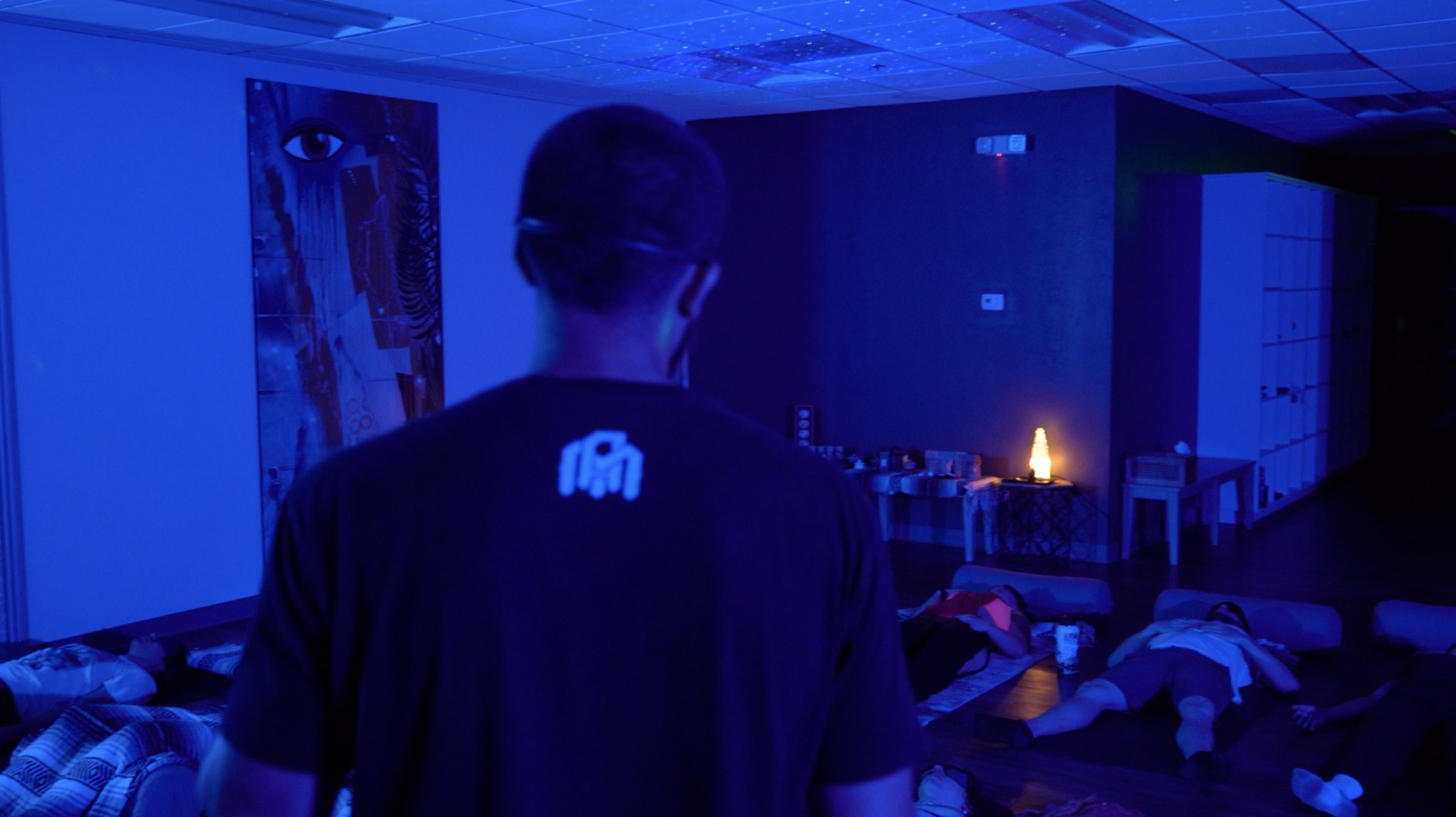
This 9D Breathwork review answers the two questions people ask us most: how much is 9D Breathwork, and is it legit? We have facilitated over 1,000 Breathwork sessions, including headphone-based ones. We trained in SOMA Breath®, Somatiq, and Rebirthing, and we have worked with facilitators who started in 9D. We also run our own Breathwork training, so read this as a competitor's view, one of several 9D Breathwork reviews worth weighing.
9D Breathwork is a registered trademark of its owner. Liquid Breathwork is not affiliated with it.
What Is 9D Breathwork?
9D Breathwork pairs circular connected breathing, the same continuous inhale-exhale pattern used in Holotropic and Rebirthing Breathwork, with a multi-layered audio track made for headphones. The "9D" refers to nine dimensions of audio engineering: binaural beats, isochronic tones, solfeggio frequencies, 8D spatial audio, brainwave entrainment, subliminal affirmations, nature soundscapes, music composition, and guided voice coaching. Our 9D Breathwork explained guide walks through a full session.
Brian Kelly created the format and grew it online through podcasts, social media, and a practitioner network.
9D Breathwork Cost: What You Pay
The 9D Breathwork price depends on whether you take sessions or teach them.
- As a participant: 9D publishes no prices on its site or in its shop, and it sells no single tracks. The app is free with a 7-day trial. Apple lists subscriptions at $67, $97, and $99 a month and $399 and $699 a year, and Google Play lists in-app purchases from $64.99 to $699.99.
- As a facilitator (certification): the 9D Breathwork facilitator training cost is not published. Their cost page says pricing is tiered, changes by cohort, and is shared on a call. Most cohorts have payment plans. Their facilitator terms do publish a $200 monthly subscription for the track library and brand access, on a 12-month term that auto-renews. You must also facilitate with 9D Breathwork headphones bought from them.
We checked their three pricing pages on September 17, 2026, and their app page, shop, and both app store listings on September 19, 2026.
The only 9D Breathwork certification cost you can confirm in writing is the subscription, and it runs as long as you deliver 9D-branded sessions. Stop paying and you lose the library and the brand. To learn how much it costs to become a 9D Breathwork facilitator, ask on the call for the full first-year 9D Breathwork training cost: tuition, subscription, and headphones.
For comparison, Liquid Breathwork's in-person facilitator training is $1,997 one time. Our breathwork certification cost breakdown has 2026 numbers across the industry.
What 9D Breathwork Does Well
- Production quality. The tracks are some of the most technically polished audio in Breathwork.
- Brand recognition. Wellness studios know the name, and the global facilitator community is active.
- It works from anywhere. Sessions and training are online. That matters where live options are thin.
- An easy start. A new facilitator presses play and holds space while the track carries the structure.
Where 9D Breathwork Falls Short
These gaps come from our own headphone sessions and from 9D facilitators who later trained with us.
- You learn one proprietary protocol. A slow somatic session for a trauma-sensitive client, a calming pranayama, or a Rebirthing-style session are not in the kit.
- Every session runs on a pre-recorded file. You cannot slow the music when the room needs two more minutes, or drop into silence when the group finds something on its own.
- Training is online only. If you want in-person practicum hours with a teacher in the room, look elsewhere.
Is 9D Breathwork Worth It?
For a participant, the free trial is an easy yes. Before it renews, weigh the $67-plus monthly plan against a local drop-in class.
For a facilitator, 9D fits if you want a turnkey audio protocol with a known brand and are happy training online. If you want to run live rooms with your own music and pacing, look elsewhere.
9D Breathwork vs Liquid Breathwork
| Factor | 9D Breathwork | Liquid Breathwork |
|---|---|---|
| Cost | Tuition quoted on a call, plus $200/month after you certify | $1,997 one-time, payment plans available |
| Format | Online-only, asynchronous + live calls | 3-day in-person immersive (Phoenix area) or 12-week online cohort |
| Techniques | Single proprietary 9D audio protocol | Multi-technique (conscious connected, somatic, pranayama, sound) |
| Cohort | Large, global, online | Small, capped for individual attention |
| Business training | Add-on / community | Included in tuition |
For more detail, see our 9D Breathwork alternative comparison and the best Breathwork certifications guide.
Frequently Asked Questions
How much does 9D Breathwork cost?
Participant plans start at $67 a month after a free 7-day trial. Facilitator tuition is quoted on a call, then $200 a month once you certify, on a 12-month term that auto-renews, plus 9D headphones bought from them.
Is 9D Breathwork legit or a scam?
It is legit, not a scam. The certification is a brand-specific credential, not a government license. That is normal: no government body licenses Breathwork in the US, so every credential comes from the training organization.
Who is Brian Kelly, the founder of 9D Breathwork?
Brian Kelly is generally credited as the creator of the 9D format, which emerged in the UK around 2020 to 2022, a newer lineage than Holotropic (1970s, Stan and Christina Grof) or Rebirthing (1970s, Leonard Orr).
What is the best alternative to 9D Breathwork?
For small-cohort, in-person training with mentorship and business training included, Liquid Breathwork. For a global online community, SOMA Breath. For trauma-informed online training, Pause Breathwork®. For retreat immersion, Alchemy of Breath. Our 9D alternative comparison covers the in-person decision.
Learn Breathwork in a Room
Our training is three days in person in the Phoenix area, across several techniques.